


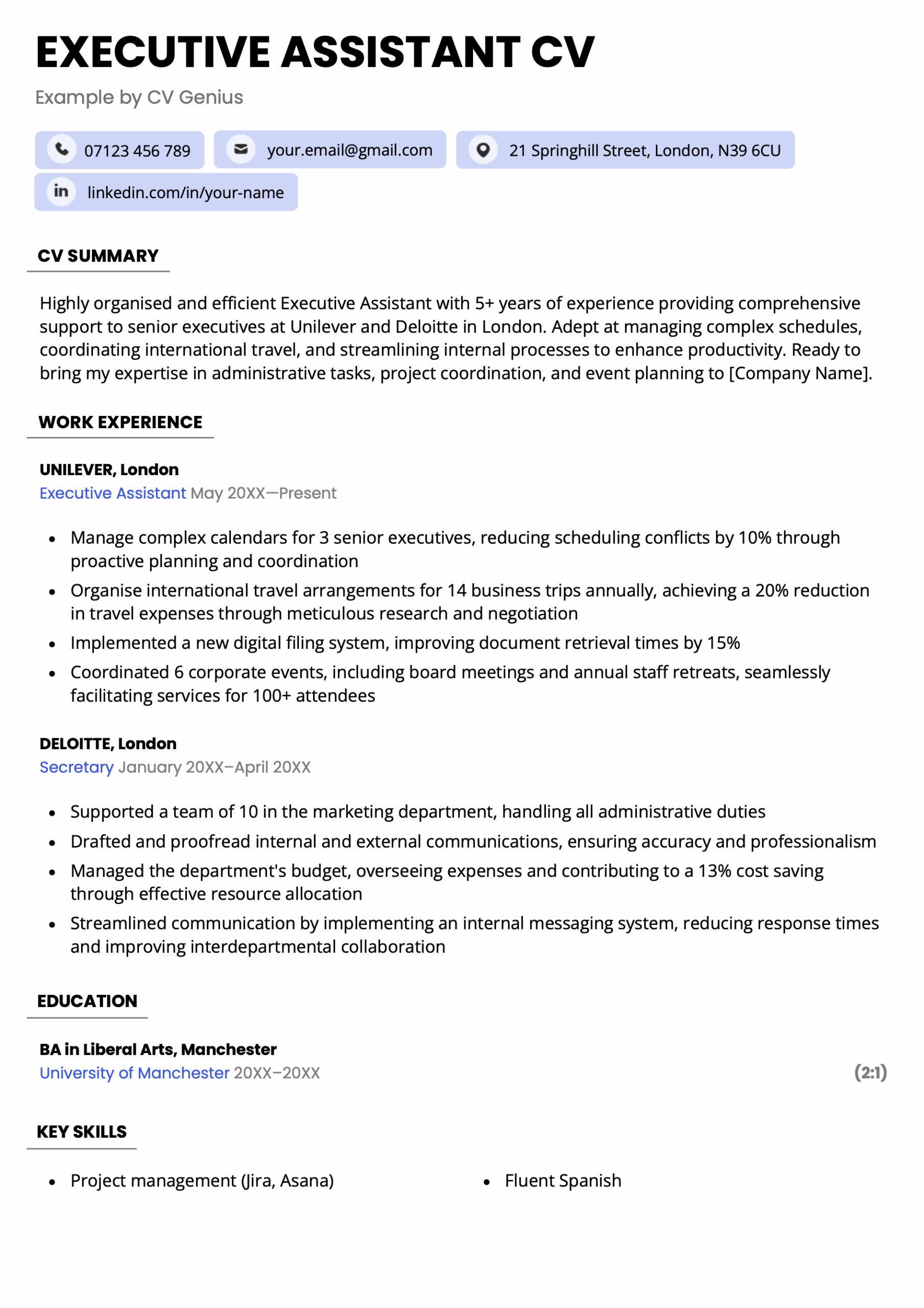
Executive Assistant CV Template (Text Format)
CV SUMMARY
Highly organised and efficient Executive Assistant with 5+ years of experience providing comprehensive support to senior executives at Unilever and Deloitte in London. Adept at managing complex schedules, coordinating international travel, and streamlining internal processes to enhance productivity. Ready to bring my expertise in administrative tasks, project coordination, and event planning to [Company Name].
WORK EXPERIENCE
Executive Assistant, May 20XX–Present
Unilever, London
- Manage complex calendars for 3 senior executives, reducing scheduling conflicts by 10% through proactive planning and coordination
- Organise international travel arrangements for 14 business trips annually, achieving a 20% reduction in travel expenses through meticulous research and negotiation
- Implemented a new digital filing system, improving document retrieval times by 15%
- Coordinated 6 corporate events, including board meetings and annual staff retreats, seamlessly facilitating services for 100+ attendees
Secretary, January 20XX–April 20XX
Deloitte, London
- Supported a team of 10 in the marketing department, handling all administrative duties
- Drafted and proofread internal and external communications, ensuring accuracy and professionalism
- Managed the department’s budget, overseeing expenses and contributing to a 13% cost saving through effective resource allocation
- Streamlined communication by implementing an internal messaging system, reducing response times and improving interdepartmental collaboration
EDUCATION
BA in Liberal Arts (2:1), Manchester
University of Manchester 20XX–20XX
KEY SKILLS
- Project management (Jira, Asana)
- Fluent Spanish
How to write an executive assistant CV
When applying for an executive assistant role, write your CV so that it highlights your ability to handle complex responsibilities, manage time effectively, and maintain a high standard of professionalism.
Here are three expert tips to help you write a standout executive assistant CV that grabs the attention of top employers:
1. Emphasise your executive-level skills
Executive assistants need to master both hard and soft skills to keep up with the high-level demands of their employers. Your CV should showcase the full range of abilities you offer to let recruiting managers see what you’re capable of.
Here are some key hard skills to add to your CV:
- Calendar and diary management: Showcase experience managing busy, multi-person schedules.
- Travel co-ordination: Detail your ability to arrange complex international and domestic travel, ensuring cost efficiency.
- Project management: List any projects you’ve overseen, whether for office moves, events, or process improvements.
- Technical proficiency: Include tools you’re skilled in, such as Microsoft Office Suite, Google Workspace, Asana, Trello, and expense management software.
- Event planning: Highlight experience organising board meetings, conferences, or retreats.
And here are some core soft skills executive assistants can consider adding to their CVs:
- Organisation: Essential for managing multiple tasks and deadlines seamlessly.
- Communication: Critical when liaising with executives, clients, and teams.
- Problem-solving: Show how you think on your feet to handle unexpected challenges.
- Discretion: Highlight your ability to handle sensitive and confidential information.
- Adaptability: Emphasise your comfort in fast-paced, high-pressure environments.
Carefully review the job description and prioritise the skills it highlights. For example, if the job calls for advanced travel co-ordination, include specifics like:
Organised 14 international business trips per year, negotiating with vendors to reduce travel costs by 20%.
Remember to only include skills you’ve mastered on your CV. Otherwise, employers might find out you’ve lied on your CV when you come in for an interview and they ask you about them.
2. Quantify your executive assistant experience
Numbers help employers quickly understand your impact and capability. Whenever possible, quantify your CV achievements to show the scale and results of your work. Doing so will give recruiting managers an idea of what you can accomplish, making it more likely they’ll consider you for an interview.
Examples of how to use numbers on your executive assistant CV
- Calendar management: Mention the number of executives you supported and how many appointments you scheduled
- Travel co-ordination: Include the number of trips handled and any savings you secured
- Event planning: State the number of attendees or events you co-ordinated
- Process improvements: Share percentage improvements, such as faster document retrieval or reduced costs
- Team support: Note how many people or departments you’ve supported
Examples of numbers on an executive assistant CV
- Managed complex diaries for 3 senior executives, ensuring 100% on-time meeting attendance and resolving 50+ scheduling conflicts monthly
- Managed complex diaries for 4 senior executives at BT Group, scheduling 150+ meetings per month and reducing scheduling conflicts by 20%
- Organised international travel for 12 business trips annually at PwC, negotiating vendor contracts that cut travel costs by 18%
- Co-ordinated 8 corporate events, including annual board meetings for 100+ attendees at Nationwide Building Society, all delivered on time and under budget
- Implemented a digital filing system at John Lewis Partnership, improving document retrieval speeds by 30% across the department
- Oversaw the marketing department’s £80,000 budget at Tesco HQ, achieving a 10% saving through effective supplier negotiations
- Supported the CEO and executive team at Barclays by handling high-volume correspondence, processing 200+ emails daily with a 98% response rate within 24 hours
- Led the transition to hybrid working at Rolls-Royce, co-ordinating IT and HR teams to onboard 60 employees to remote systems within 2 weeks
- Managed travel logistics for 5 board members at the BBC, including complex multi-leg European trips, with 100% on-time arrivals
- Spearheaded office move for Deloitte’s Birmingham branch, co-ordinating 50+ team members and external vendors, completing the relocation 2 days ahead of schedule
- Mentored 3 junior assistants at AstraZeneca, improving onboarding time for new EAs by 25% through a streamlined training programme
- Implemented a new filing system, cutting document retrieval times by 15%
These numbers give recruiters clear proof of your skills and the scope of your responsibilities, making it more likely they’ll want to hire you since they can see what you’re capable of doing within their own firm.
3. Highlight your leadership and initiative
While executive assistants support other leaders, they also take initiative to improve operations and processes. Use your CV to demonstrate your leadership skills in areas such as:
- Introducing new systems (e.g., filing, messaging platforms)
- Leading budget management or expense tracking
- Acting as a liaison between executives and teams
- Mentoring junior assistants or team members
How to write a cover letter for your executive assistant CV
After you make a CV for executive assistant work, it’s crucial to learn how to write a compelling cover letter that makes a strong first impression on the employer.
A good cover letter personalises your executive assistant application by demonstrating how your skills and experiences align with the employer’s needs.
So here’s how to build an effective cover letter:
- Personalise the greeting: Address the hiring manager by name to establish a personal connection right from the start of your cover letter — for example, ‘Dear Mr Ankari,’.
- Highlight key achievements: Provide more details on significant accomplishments from your executive assistant CV that are relevant to the job you’re applying for, using hard numbers to emphasise your successes.
- Show enthusiasm: Express your genuine interest in the executive assistant role and the company, explaining what motivated you to apply.
- End with a call to action: End with a proactive statement inviting the recruiting manager to contact you for a job interview.
Remember to tweak your cover letter to tailor it to each job you apply for. Even mentioning the employer by name and changing a few words of your letter to address their needs will give your application a personalised feel.
Executive assistant job outlook in 2026 — things to know
According to the UK Earnings Explorer provided by the Office for National Statistics (ONS), executive assistants in the UK earn an average annual salary of £22,927.
Additionally, there are similar pay levels for both men and women in this type of role.
Data source
This data was collected by the Office for National Statistics, an agency of HM Government.
The information contains public sector information licensed under the Open Government Licence v3.0 and reflects the ONS’s most recent salary (1/11/2023), gender pay gap (4/2023), and skills shortage data (6/2022).
Skip the writer’s block and make a CV in minutes with our AI software.
More CV & Cover Letter Examples:








Copy Link
Facebook
Linkedin
Twitter
Pinterest