


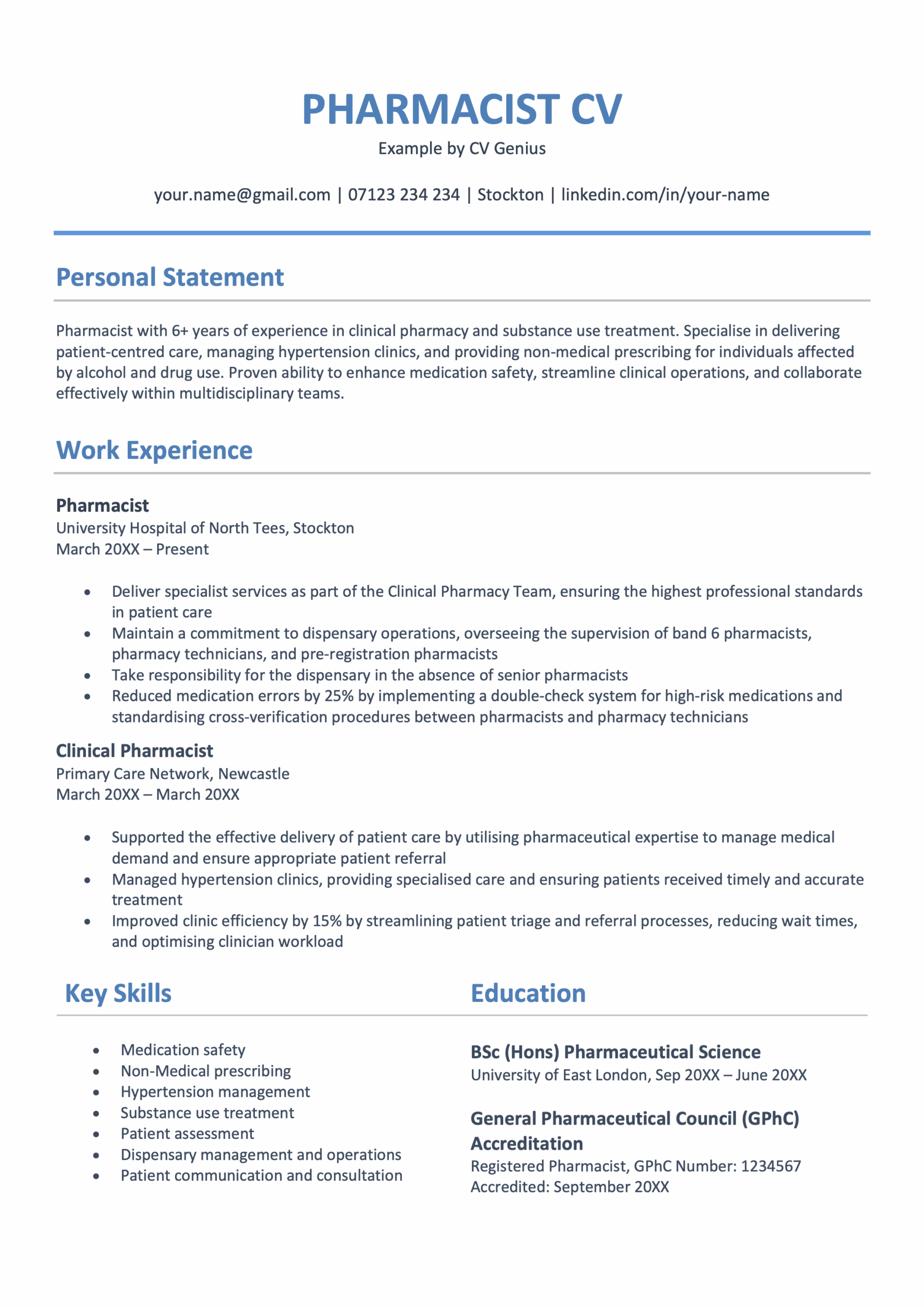
Pharmacist CV Template (Text Format)
PERSONAL STATEMENT
Pharmacist with 6+ years of experience in clinical pharmacy and substance use treatment. Specialise in delivering patient-centred care, managing hypertension clinics, and providing non-medical prescribing for individuals affected by alcohol and drug use. Proven ability to enhance medication safety, streamline clinical operations, and collaborate effectively within multidisciplinary teams.
WORK EXPERIENCE
Pharmacist
University Hospital of North Tees, Stockton
March 20XX – Present
- Deliver specialist services as part of the Clinical Pharmacy Team, ensuring the highest professional standards in patient care
- Maintain a commitment to dispensary operations, overseeing the supervision of band 6 pharmacists, pharmacy technicians, and pre-registration pharmacists
- Take responsibility for the dispensary in the absence of senior pharmacists
- Reduced medication errors by 25% by implementing a double-check system for high-risk medications and standardising cross-verification procedures between pharmacists and pharmacy technicians
Clinical Pharmacist
Primary Care Network, Newcastle
March 20XX – March 20XX
- Supported the effective delivery of patient care by utilising pharmaceutical expertise to manage medical demand and ensure appropriate patient referral
- Managed hypertension clinics, providing specialised care and ensuring patients received timely and accurate treatment
- Improved clinic efficiency by 15% by streamlining patient triage and referral processes, reducing wait times, and optimising clinician workload
KEY SKILLS
- Medication safety
- Non-Medical prescribing
- Hypertension management
- Substance use treatment
- Patient assessment
- Dispensary management and operations
- Patient communication and consultation
EDUCATION
BSc (Hons) Pharmaceutical Science
University of East London, Sep 20XX – June 20XX
General Pharmaceutical Council (GPhC) Accreditation
Registered Pharmacist, GPhC Number: 1234567
Accredited: September 20XX
How to write an impressive pharmacist CV
To get hired as a pharmacist, you’ll need to show employers that you have the proper medical knowledge, technical skills, and qualifications for safely supplying medication to the general public.
Here’s how to write a comprehensive pharmacist CV that covers all the bases.
1. Cover the essentials in your personal statement
Your personal statement should outline your level of experience, mentioning your GPhC accreditation so the employer knows you are qualified to practise in the UK.
Convey any specific areas of pharmacy you specialise in, such as clinical pharmacy, primary care, or substance use treatment. You should also mention any specialisations or certifications, such as being a Non-Medical Prescriber.
Highlighting the right soft skills is helpful too. Emphasise your people skills by outlining how your approach to prescription and care has improved patient outcomes.
Example pharmacist personal statement
Results-oriented Pharmacist with 8 years of experience in hospital pharmacy, chronic disease management, and patient education (GPhC Reg No: 1234567). Specialise in oncology pharmacy, delivering personalised medication management, and non-medical prescribing for cancer patients. Proven track record in reducing medication errors, improving patient adherence to complex treatment regimens, and leading multidisciplinary teams in developing innovative care protocols. Seeking to leverage my expertise in oncology and chronic disease management to enhance patient outcomes and support the team at St. George’s Hospital.
If you’re struggling to find the right words or are preparing your pharmacist CV under a tight deadline, you can also try generating a unique personal statement using an AI CV maker.
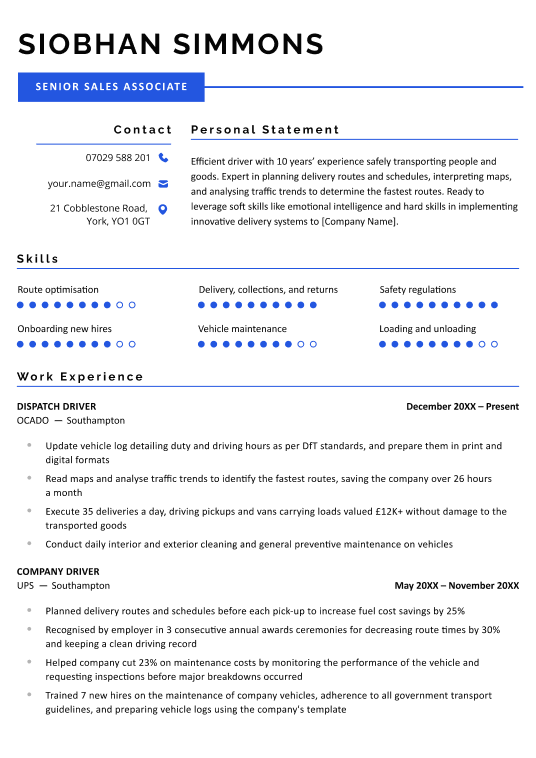
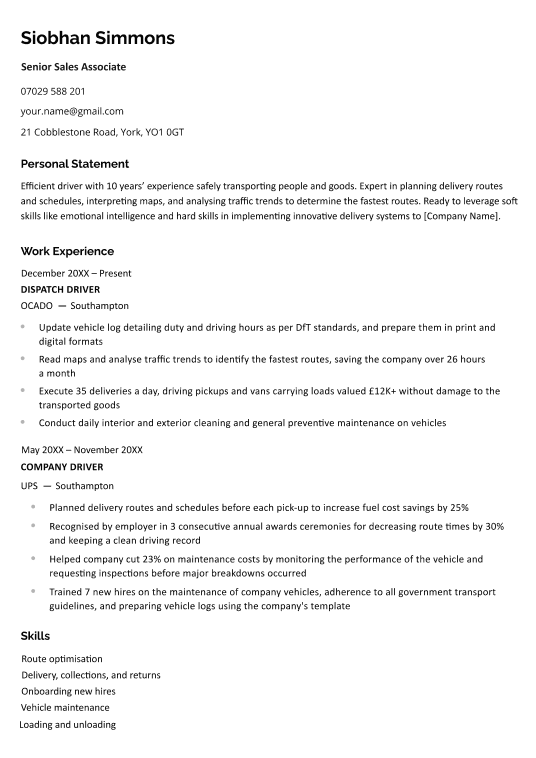
Skip the writer’s block and make a CV in minutes with our AI software.
2. Write a thorough work experience section
Each entry in your work experience section should include a clear description of your primary responsibilities, as well as specific details that reflect the scope of your experience.
For example, you could say that you managed dispensary operations, and then specify that you oversaw a team of pharmacists and technicians and managed inventory for high-risk medications in the bullet points that follow. This approach will make your entries easy to skim while providing detailed insight into the environments you’ve worked in.
If you’re applying for a job that requires specialised knowledge in certain areas (e.g., oncology, substance use treatment, or chronic disease management) tailor each entry to the requirements by highlighting your relevant achievements.
Example work experience section for a pharmacist
Senior Clinical Pharmacist
St Mary’s Hospital, London
April 20XX – Present
- Lead dispensary operations, overseeing a team of 10 pharmacists and pharmacy technicians, ensuring accurate and efficient dispensing of medications in a high-volume hospital setting
- Spearheaded a multidisciplinary initiative to optimise medication protocols for oncology patients, resulting in a 15% reduction in adverse drug reactions and improved patient adherence to treatment plans
- Manage hypertension and diabetes clinics, providing specialised care to over 200 patients annually, and developed patient education materials that have led to a 25% increase in patient engagement and adherence to treatment
3. List your pharmacist skills
Present your key skills as a straightforward list, so hiring managers can quickly reference it for any specialisations, licences, or medical skills that make you a fit for the job.
Organise your key skills by relevance to the job description. Start with the specific specialised skills listed in the job description and then broaden out into other skills employers typically look for in your field (e.g., medication management, patient care, and collaboration with various healthcare teams).
Best skills to put on your pharmacist CV
- Medication management
- Clinical pharmacy
- Non-medical prescribing
- Pharmacy software proficiency
- Inventory management
- Regulatory compliance
- Patient assessment
- Clinical documentation
- Medication safety
- Chronic disease management
- Substance use treatment
- Dispensary operations
4. Lay out your education
To practise as a pharmacist in the UK, you’ll need the following qualifications:
- Accredited Masters degree in pharmacy (MPharm)
- One-year paid pre-registration training in a GPhC-approved pharmacy
- GPhC registration assessment
When you write your CV, lay out your qualifications chronologically, starting with the most recent qualification you obtained. If you obtained any further qualifications, such as a certification in antimicrobial stewardship or independent prescribing, you should include them in your education section.
Example of how to lay out your pharmacist education section
Independent Prescribing Certification, 20XX
University of Manchester,MPharm (Master of Pharmacy), 20XX – 20XX
University of ManchesterPre-Registration Training, July 20XX – June 20XX
Boots Pharmacy, Picadilly Branch, ManchesterGPhC Registration, 20XX
Registered Pharmacist, GPhC Number: 1234567
Pharmacist job outlook in 2026 — things to know
According to the UK Earnings Explorer provided by the Office for National Statistics (ONS), pharmacists in the UK earn an average annual salary of £39,336.
You can find information about the gender pay gap for pharmacists on the ONS’ website.
More CV & Cover Letter Examples:









Copy Link
Facebook
Linkedin
Twitter
Pinterest