


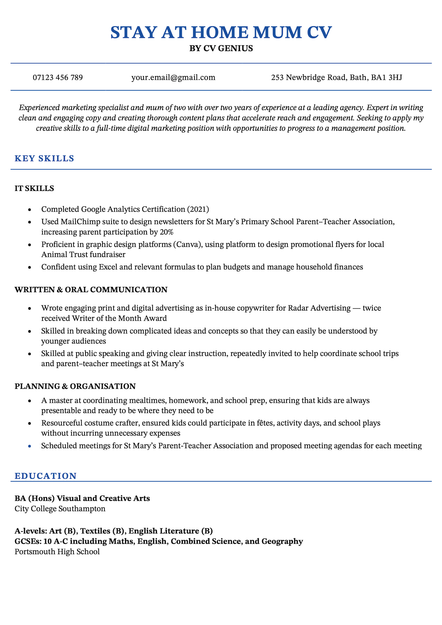
Stay at Home Mum CV Template (Text Format)
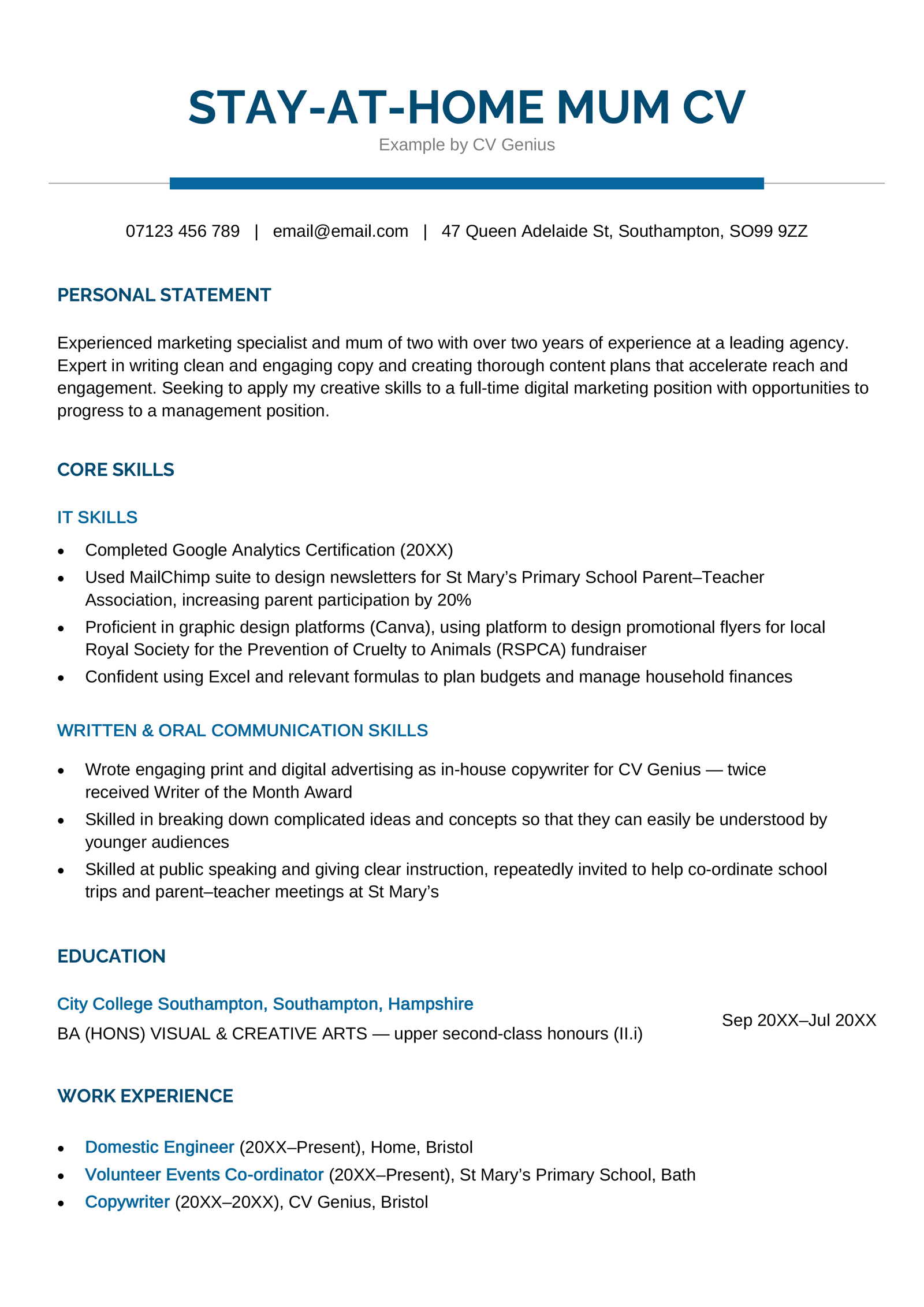
PERSONAL STATEMENT
Experienced marketing specialist and mum of two with over two years of experience at a leading agency. Expert in writing clean and engaging copy and creating thorough content plans that accelerate reach and engagement. Seeking to apply my creative skills to a full-time digital marketing position with opportunities to progress to a management position.
CORE SKILLS
IT Skills
- Completed Google Analytics Certification (20XX)
- Used MailChimp suite to design newsletters for St Mary’s Primary School Parent–Teacher Association, increasing parent participation by 20%
- Proficient in graphic design platforms (Canva), using platform to design promotional flyers for local Royal Society for the Prevention of Cruelty to Animals (RSPCA) fundraiser
- Confident using Excel and relevant formulas to plan budgets and manage household finances
Written & Oral Communication Skills
- Wrote engaging print and digital advertising as in-house copywriter for CV Genius — twice received Writer of the Month Award
- Skilled in breaking down complicated ideas and concepts so that they can easily be understood by younger audiences
- Skilled at public speaking and giving clear instruction, repeatedly invited to help co-ordinate school trips and parent–teacher meetings at St Mary’s
EDUCATION
City College Southampton, Southampton, Hampshire
BA (Hons) Visual & Creative Arts — Upper Second-Class Honours (II.i)
Sep 20XX–Jul 20XX
WORK EXPERIENCE
- Domestic Engineer (20XX–Present), Home, Bristol
- Volunteer Events Co-ordinator (20XX–Present), St Mary’s Primary School, Bath
- Copywriter (20XX–20XX), CV Genius, Bristol
How to write a stay-at-home mum CV
The decision to return to work after a childcare break brings a lot of questions. How do you justify an employment gap? What do you do if you haven’t worked in years or have no experience at all? How do you put ‘stay-at-home mum’ (or ‘dad’) on a CV? Should you even mention it in the first place?
Firstly, being a stay-at-home mum (or dad) shouldn’t take away from your skills and experience. Research has shown that returning mothers who are upfront about their childcare breaks are significantly more likely to be hired than those who hide them.
Regardless of when you quit your last job, an optimised stay-at-home mum CV will emphasise your professional capabilities over when you were last in the workplace.
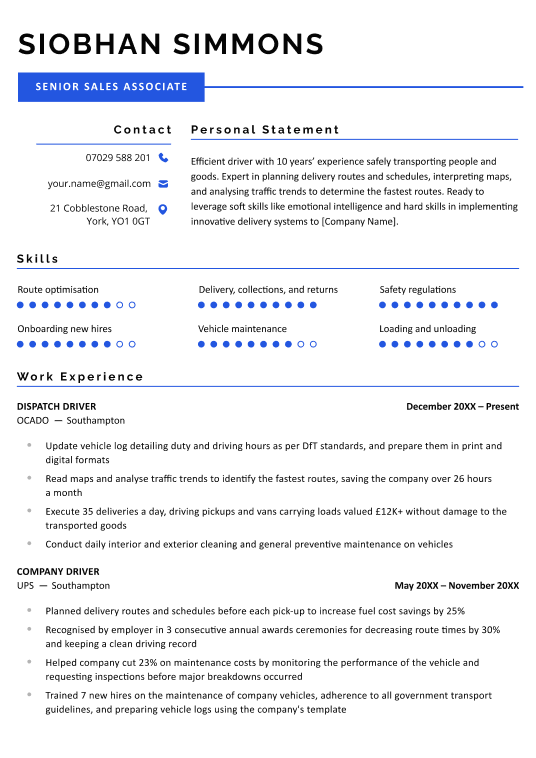
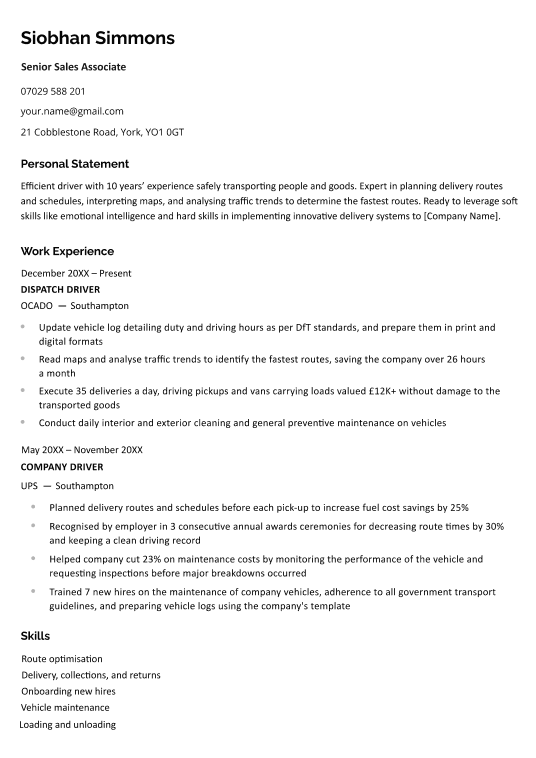
Skip the writer’s block and make a CV in minutes with our AI software.
Here are three tips to help you write a CV that streamlines your return to the workplace.
1. Give yourself a job title that reflects your ambitions
A job title is a name that describes your professional position. It appears in the header of your CV, right after your full name, so it’s one of the first things employers will see.
Whether you describe yourself as a parent in your job title depends on your immediate professional goals.
If you’re applying for a technical position or one you already have significant experience and certifications in, create a job title that’s relevant to that role. For example, if you’re applying for a PR job, you might describe yourself as a ‘communications specialist.’
Describing yourself as a parent can be helpful if you’re applying for a role that primarily requires transferable skills — skills that are used across industries. Here are just a few examples of jobs where transferable skills are highly valuable:
- Customer service
- Administrative assistant
- Teacher
- Carer
- Operations manager
- Sales associate
If you do describe yourself as a parent in your job title, avoid dated or unprofessional titles like ‘housewife’, ‘househusband’, or ‘stay-at-home mummy.’
Also, be sure to highlight your relevant skills in your personal statement and skills sections.
2. Choose the right format for your stay-at-home mum CV
The best CV format for a stay-at-home mum or dad CV depends on how much formal relevant experience you have.
If you have little relevant experience or want to transition to a different career, use a skills-based CV format. If you’re continuing a career you already have experience in, use a chronological CV.
Skills-based CVs
In a skills-based CV (also known as a functional CV), you focus on your relevant skills rather than previous work experience. Focus on your skills by listing your skills section after your personal statement, but before your work experience and education sections.
Here’s how to write your skills correctly:
- Think of key skills that you’ve gained in previous roles, during your education, or when accomplishing other achievements
- Read through the job description and job descriptions for similar roles to find out what employers are looking for
- List three to four skills that are essential to the open position
- For each skill, include three to four bullet points explaining why you’re capable of this skill and list relevant achievements you made using the skill
As your work history is less prominent on a skills-based CV, the employer is encouraged to think about what you’re capable of doing rather than where you worked previously.
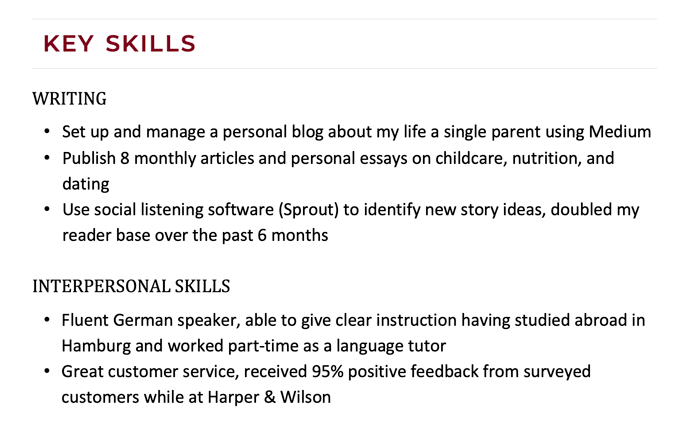
By focusing on your skills, you can highlight the achievements and skills you accumulated during your childcare break and easily tailor your CV to the job you’re applying for:
Reverse chronological CV
You’re probably familiar with the chronological CV format. It lists work experience first under the personal statement and lists previous jobs in reverse chronological order, starting with your most recent job.
You may wonder if a chronological CV is the right choice for a parent returning to the workplace, as gaps between employment are visible. However, a chronological CV can emphasise the extent of your experience if you have several years of relevant work history.
Moreover, employers understand that childcare is a valid reason to take an extended break between jobs.
Employment gaps only hurt applications when they’re frequent and unaccounted for.
That said, you can downplay the length of your employment gaps if you only list the years of your employment rather than the months and years.
You should also remember that as parental leave is a legal right in the UK, you can factor it into your official employment time if you were using shared parental leave while working in a previous role.
3. Write an attention-grabbing personal statement
Your personal statement is a professional self-introduction highlighting your notable experience, skills, achievements, and career direction.
Whether you highlight your parental role or focus on your professional history, it should grab the employer’s attention and encourage them to thoroughly read your CV.
Your personal statement should describe your:
- work experience
- expertise
- achievements
- career objectives
As a parent returning to the workforce, you may choose to highlight some of the transferable skills you developed during your break. Transferable skills aren’t specific to a single industry, nor do you necessarily learn them on the job. Highly valuable transferable skills such as communication, time management, and leadership can all be highlighted while describing your role as a parent.
Here’s a great personal statement for a stay-at-home mum’s CV:
Stay-at-home mum with 6+ years of experience in customer service. Excellent track record at home and on the job of responding to complaints and unexpected incidents in a calm and reassuring manner. With leadership experience as both a team leader and volunteer co-ordinator at my local community centre, I am seeking to bring my well-rounded skill set to a remote management position.
When considering whether to include parental skills in your personal statement, read the job description. If the employer is looking for a transferable skill that you can demonstrate by describing your parental experience, then leading with ‘stay-at-home mum’ may be what helps you get the role.
More CV & Cover Letter Examples:





Copy Link
Facebook
Linkedin
Twitter
Pinterest