


Mechanic CV template (text format)
PERSONAL STATEMENT
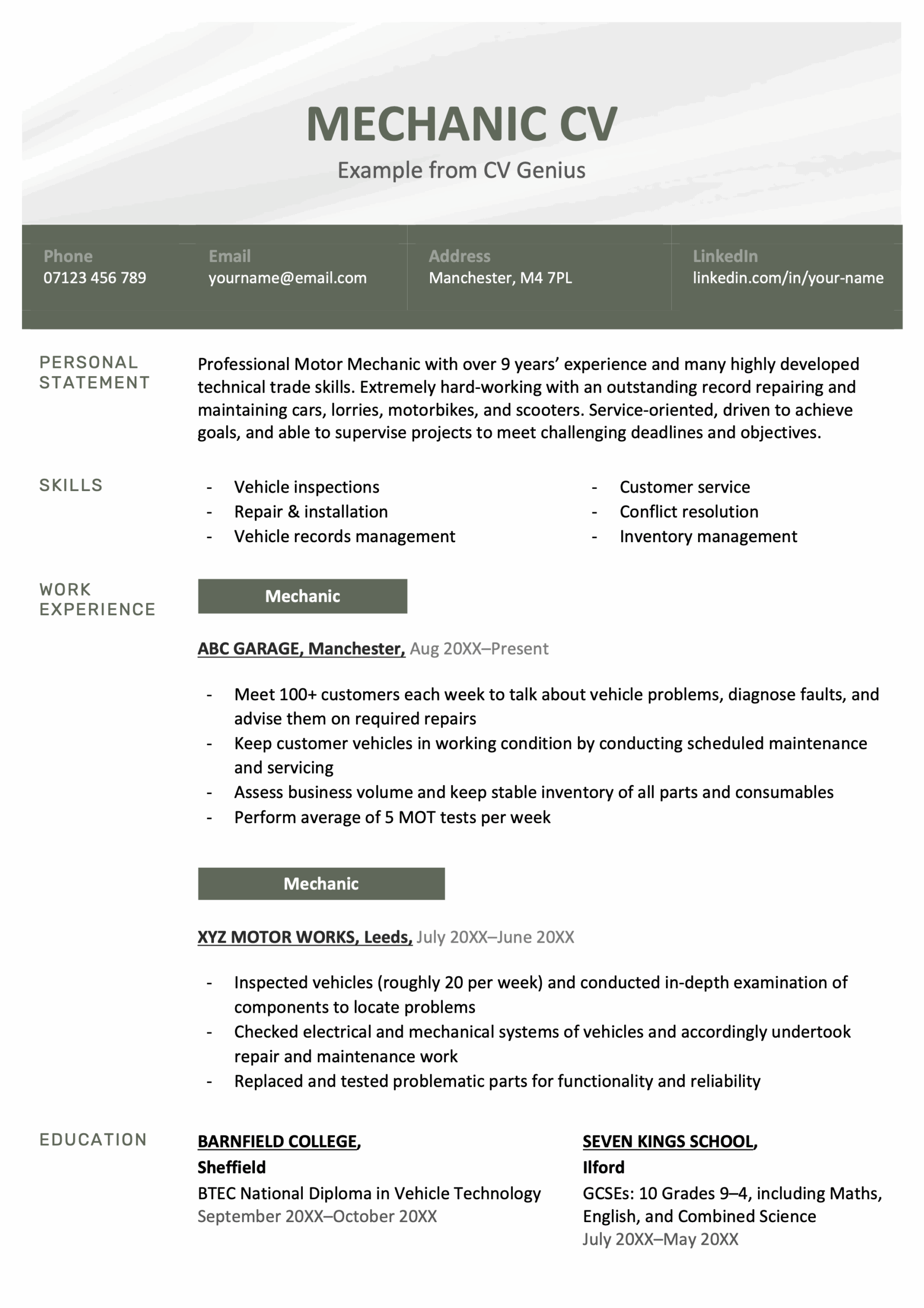
Professional Motor Mechanic with over 9 years’ experience and many highly developed technical trade skills. Extremely hard-working with an outstanding record repairing and maintaining cars, lorries, motorbikes, and scooters. Service-oriented, driven to achieve goals, and able to supervise projects to meet challenging deadlines and objectives.
SKILLS
- Vehicle inspections
- Repair & installation
- Vehicle records management Customer service
- Conflict resolution
- Inventory management
WORK EXPERIENCE
Mechanic
ABC Garage, Manchester, Aug 20XX–Present
- Meet 100+ customers each week to talk about vehicle problems, diagnose faults, and advise them on required repairs
- Keep customer vehicles in working condition by conducting scheduled maintenance and servicing
- Assess business volume and keep stable inventory of all parts and consumables
- Perform average of 5 MOT tests per week
Mechanic
XYZ Motor Works, Leeds, July 20XX–June 20XX
- Inspected vehicles (roughly 20 per week) and conducted in-depth examination of components to locate problems
- Checked electrical and mechanical systems of vehicles and accordingly undertook repair and maintenance work
- Replaced and tested problematic parts for functionality and reliability
EDUCATION
Barnfield College, Sheffield, September 20XX–October 20XX
BTEC National Diploma in Vehicle Technology
Seven Kings School, Ilford, July 20XX–May 20XX
GCSEs: 10 Grades 9–4, including Maths, English, and Combined Science
How to write your mechanic CV
Whether you’re looking for a apprenticeship or a full-time position, your mechanic CV needs to demonstrate the right technical knowledge in a clear, easy-to-follow format.
Use the tips below to write a professional CV that focuses on the right qualifications and achievements for your target role.
1. Start with a strong personal statement
A good personal statement hooks the employer by summarising your most relevant skills and achievements in 3–4 sentences or bullet points.
As a mechanic, technical ability should be your main focus. Employers will want to know whether you have the right certifications and industry knowledge for their specific job opportunity.
If you have previous experience in the role, include evidence your ability to perform the job’s main responsibilities. The following personal statement is a great example, highlighting a strong track record in vehicle maintenance.
Professional Motor Mechanic with over 9 years’ experience and many highly-developed technical trade skills. Extremely hard-working with an outstanding record of success and achievement on the job — repairing and maintaining different vehicles ranging from cars and lorries to motorbikes and scooters. Service-oriented, driven to achieve goals, and able to supervise projects to meet challenging deadlines and objectives.
If you’re writing your CV with no previous experience and can’t provide on-the-job evidence of your skills, emphasise your training and career goals in your personal statement.
2. Use the right structure for your experience level
The standard way to format a CV is by focusing on your practical experience and industry achievements. The best way to achieve this focus is by using the following structure (provided you have work experience):
- Contact information: Give your phone number, email, and town or city
- Personal statement: Summarise your mechanical experience and the types of vehicles or equipment you’ve worked on
- Work experience: List your previous jobs in reverse, with 3–5 bulleted achievements or responsibilities under each entry
- Education: Include apprenticeships and certifications — and your highest level of formal education (e.g., GSCEs, A levels, or a university degree)
- Relevant skills: Focus on 5–10 technical mechanic skills that align with the specific role
If this is your first time applying for a mechanic job and you don’t have any similar work experience, write a skills-based CV instead:
- Contact information: Include the same basic details
- Personal statement: Focus on your training, career goals, and any transferable skills that align you with the role
- Relevant skills: Write your top skills as sub-headers, then bullet 3–4 relevant achievements from your training or personal projects
- Work experience: Briefly list each role, including the job title, employer, and employment dates
- Education: Emphasise mechanical courses, college training, or certifications that show job readiness
Here’s an example of a relevant skills section written by an early-career mechanic:
3. Give evidence of your mechanic skills in action
Just saying you have mechanic skills on your CV isn’t enough to convince a recruiter to interview you. Instead, describe your skills with examples and numbers to show specifically how you can help your target garage thrive.
For example, let’s say the job advert you’re responding to requires a mechanic who can train apprentices. Here’s an example of an unconvincing statement about apprentice mentoring, followed by a repaired version with numbers and an example:
❌ Able to train apprentice mechanics
✅ Guided 3 trainees from apprentices to full-time mechanics, delivering hands-on training and sharing useful industry knowledge
Other data and examples you can use on your mechanic CV include:
- Amounts of money saved by finding new parts providers
- Repair times reduced via developing efficient processes
- Specific mechanical issues solved
- Number of employees supervised
- Average number of customers assisted per day
Mechanic job outlook in 2026 — things to know
According to the UK Earnings Explorer provided by the Office for National Statistics (ONS), mechanics in the UK earn an average annual salary of £31,568.
You can find information about the gender pay gap for mechanic on the ONS’ website.
The ONS also notes that this role faces a skills shortage, with 58.09% of employers reporting difficulties filling similar vacancies.
To strengthen your CV for a mechanic role, highlight these key qualifications and licences:
- Complete apprenticeship
- NVQ (Level 2or 3 recommended)
- ONC/BTEC in relevant field
- Light Vehicle Repair Level 2
- MOT Tester certification
- Relevant operational licences (including driving)
If you’re missing any of these qualifications, consider enrolling in a course, training programme, or work-based learning scheme to boost your profile.
Skip the writer’s block and make a CV in minutes with our AI software.
More CV & Cover Letter Examples:









Copy Link
Facebook
Linkedin
Twitter
Pinterest