





The entry-level hiring landscape in the UK is changing faster than most graduates realise. To understand what employers now expect from early-career applicants, CV Genius surveyed 2,000 UK hiring managers across industries, regions, age groups, and genders.
Overall findings — Employers expect more, but hire less
While demand for talent remains high, the goalposts for success have shifted away from traditional indicators — such as academic achievement — and towards the qualities that make candidates job-ready from day one.
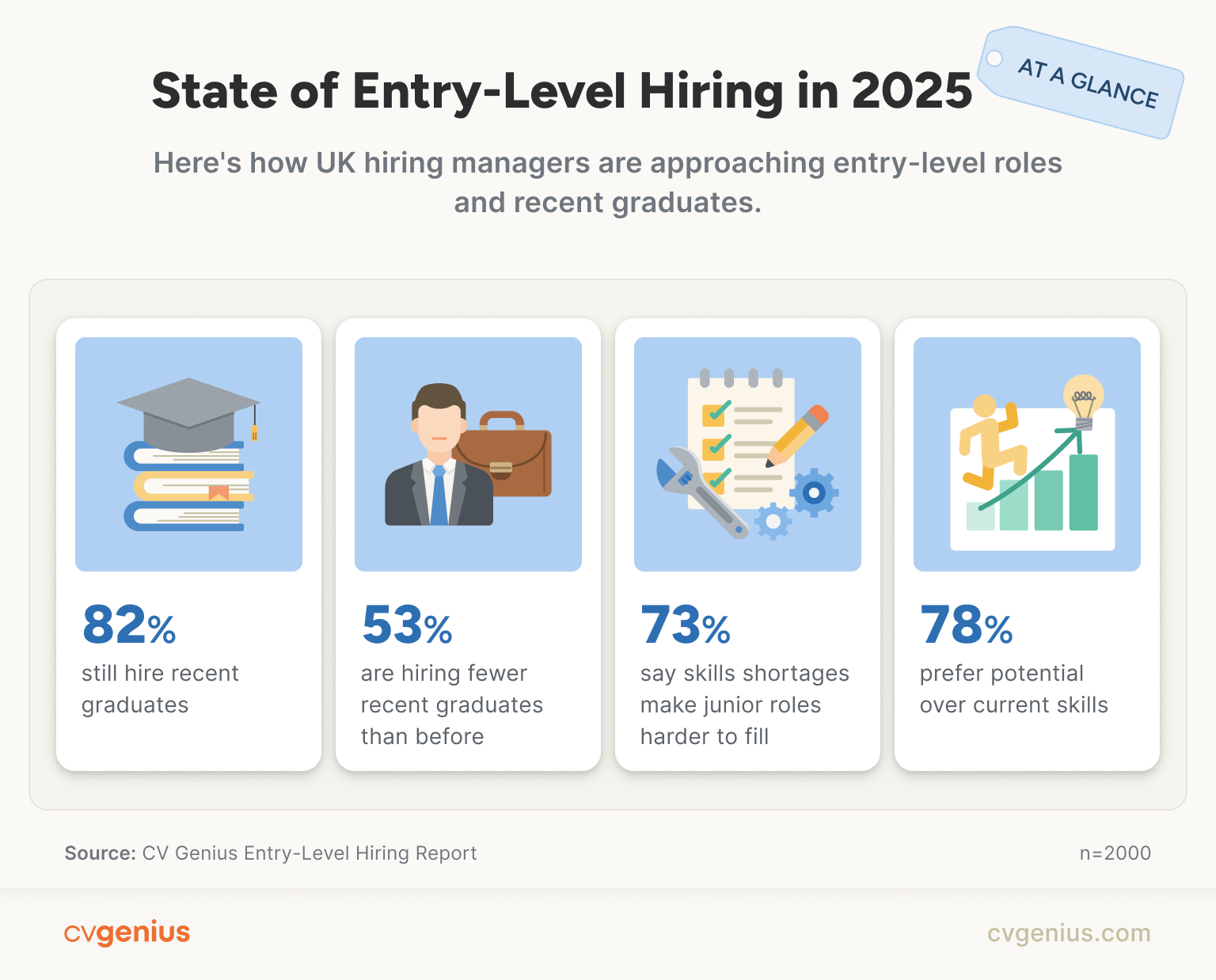
‘Entry-level’ reality check
Employers are raising the bar for what ‘entry-level’ applicants should already know, while simultaneously redefining which qualities matter most when selecting early-career candidates. The long-standing assumption that graduates can step into a role with no prior experience is rapidly fading; in practice, ‘entry-level’ now often resembles a junior-level position where employers expect meaningful contributions from candidates from day one.
80% of entry-level roles are now filled by candidates with prior experience
While job seekers often view entry-level roles as training opportunities, most are being filled by applicants with relevant work history already on their CV.
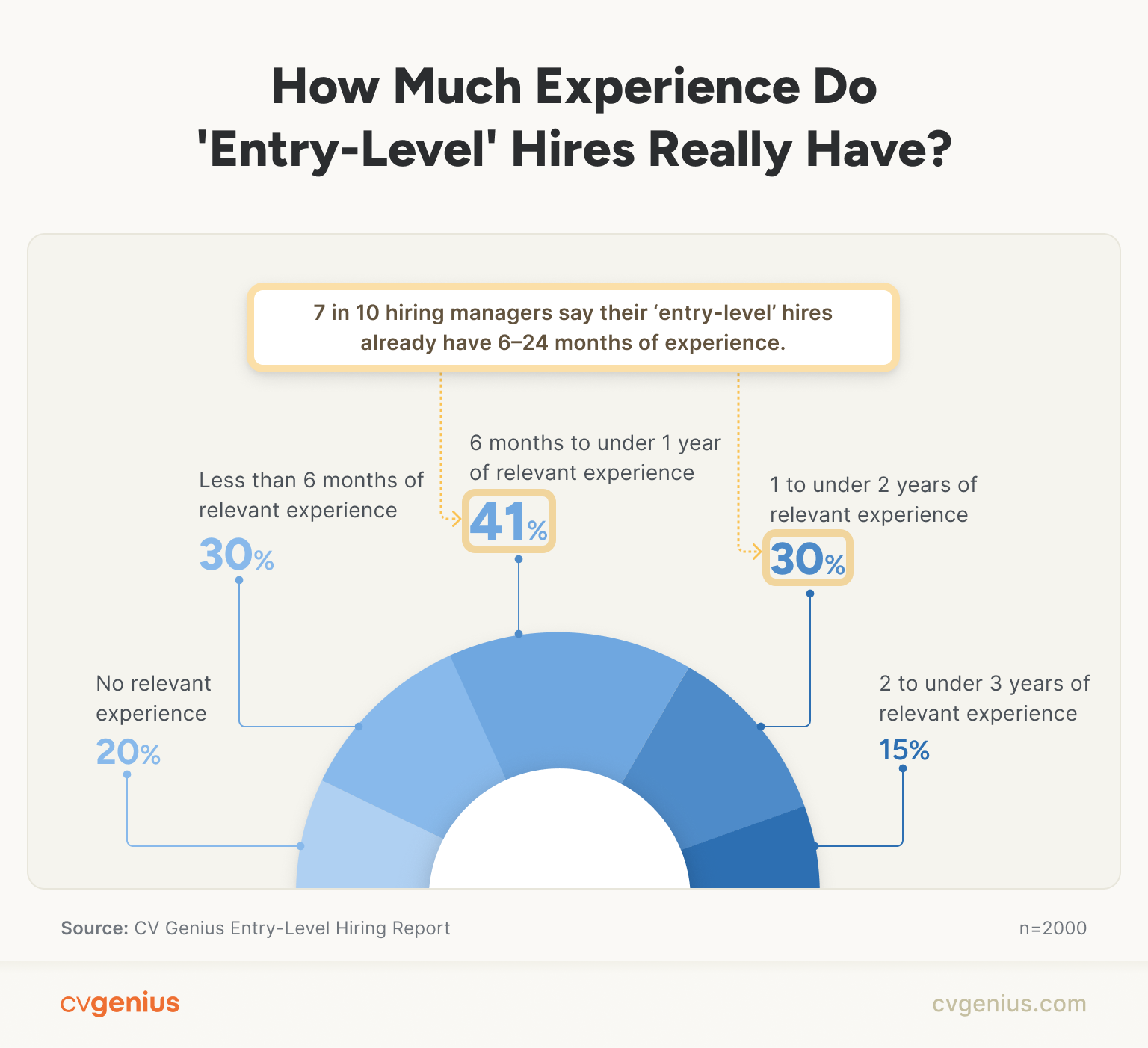
Below is a breakdown of how much experience ‘entry-level’ hires typically have, according to UK hiring managers:
- 20% say no experience
- 30% say less than 6 months
- 41% say 6 months to 1 year
- 31% say 1 to 2 years
- 15% say 2 to 3 years
The shift reflects a growing trend of ‘experience inflation’, making extracurricular work, part-time roles, and voluntary work increasingly important for graduates looking to compete.
Once candidates meet this experience threshold, our data suggests that soft skills and attitude serve as the primary differentiators over academic pedigree.
Here are some other interesting data points we observed:
- Experience is now mandatory: Only 20% of hiring managers usually hire candidates with no relevant experience. By contrast, 72% typically hire applicants with between six months and two years of experience
- Attitude over academics: Enthusiasm and a willingness to learn are the top reasons employers hire graduates (55%)
- This focus on potential over prestige is reinforced by other motivators: 50% value graduates because they can be trained to specific organisational needs, and 47% hire them to bring fresh perspectives and new ideas
Generational findings: Gen Z managers are the strictest on experience, but care least about prestige
Gen Z managers take the toughest stance on experience: they are the least likely to offer roles requiring no prior work history, yet the most willing to overlook elite university backgrounds. This suggests a generational shift towards valuing practical ‘street smarts’ and proven skills over institutional prestige.
Below is a breakdown of how much experience ‘entry-level’ hires typically have, by generation:
- No relevant experience: Gen Z (15%), Millennials (19%), Gen X (22%), Boomers (26%)
- Less than 6 months: Gen Z (31%), Millennials (28%), Gen X (32%), Boomers (34%)
- 6 months to under 1 year: Gen Z (43%), Millennials (43%), Gen X (39%), Boomers (34%)
- 1 to under 2 years: Gen Z (34%), Millennials (32%), Gen X (29%), Boomers (22%)
Here are some other interesting data points we observed:
- The zero-experience gap: Only 15% of Gen Z managers say they typically hire candidates with no experience for entry-level roles, compared with 26% of Baby Boomers who say the same
- Prestige is fading: Gen Z are the most likely to dismiss educational prestige, with 47% rating university reputation as ‘not important’, compared to just 27% of Baby Boomers
Gender findings: Men value tenure and pedigree; women prioritise potential
A clear divide emerges in how male and female hiring managers evaluate early-career talent. Men tend to hold more traditional views of what makes a candidate ‘hireable’, placing greater emphasis on longer work histories and university reputation. Women, by contrast, are more open to applicants who demonstrate the right behavioural traits, even if their experience is limited.
Below is a breakdown of how much experience ‘entry-level’ hires typically have, by gender:
- No relevant experience: Women (19%), Men (20%)
- Less than 6 months: Women (33%), Men (28%)
- 6 months to under 1 year: Women (41%), Men (41%)
- 1 to under 2 years: Women (30%), Men (31%)
- 2 to under 3 years: Women (13%), Men (17%)
Here are some other interesting data points we observed:
- The experience gap: Men are more likely than women to hire candidates with 2 to 3 years of experience for an entry-level role (17% vs. 13%)
- Soft skills vs hard stats: Women place greater weight on soft skills (64% vs. 59%). Men, meanwhile, are more likely to prioritise academic performance (41% vs 34%) and university prestige (19% vs 12%)
Human skills still dominate — AI remains secondary
Hiring managers remain far more interested in core human competencies than in technical buzzwords, revealing a disconnect between what candidates believe matters and what actually drives early-career hiring decisions. Although artificial intelligence is reshaping workplace processes, it has not yet replaced the fundamental need for resilience, communication, and adaptability in entry-level hires.
The AI distraction: only 16% of managers prioritise AI literacy in new hires
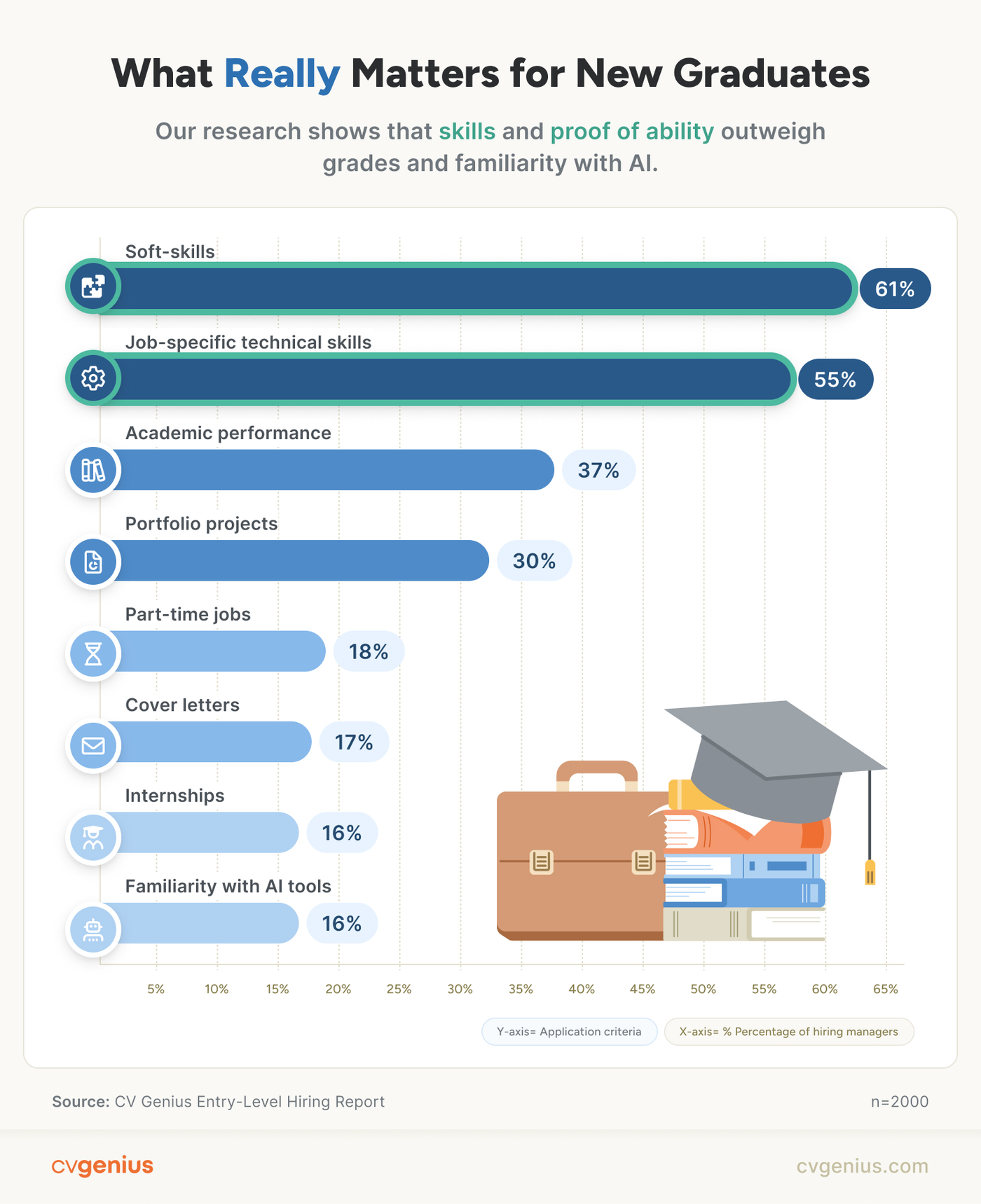
Despite the surrounding hype, AI literacy ranks low on employers’ priority lists. Only 16% of hiring managers say familiarity with AI tools is among the key qualities they look for in new graduates. Rather than treating AI capability as a decisive hiring factor, managers frame it as a useful bonus, while soft skills and technical competence remain the primary gatekeepers.
Below is the breakdown of key hiring priorities:
- Soft skills: 61%
- Job-specific technical skills: 56%
- Academic performance: 38%
- Portfolio projects: 30%
- AI familiarity: 16%
Here are some other interesting data points we observed:
- Rejection reality: Nearly 39% of hiring managers report rejecting applicants due to inadequate soft skills
- Adaptability wins: 34% of managers say that being ‘adaptable and open to feedback’ is a primary reason they choose to hire a graduate
- The skills shortage: Although technical abilities can increasingly be taught in-house, many organisations see the real skills shortage as a lack of resilience and teamwork — qualities that automation cannot replace
Generational findings: Gen Z managers value AI more, but still prioritise soft skills
A strong generational divide emerges in attitudes towards AI. Gen Z managers are the most likely to view AI skills as important and to use AI tools in the screening process. Yet even within this tech-native cohort, soft skills continue to outweigh digital capability when it comes to final hiring decisions.
Below are the percentages of hiring managers who agreed with the following statements:
‘Basic AI tool skills are important for most entry-level roles I hire for’:
- Gen Z: 60%
- Millennials: 56%
- Gen X: 46%
- Baby Boomers: 42%
‘AI is effective at assessing candidates’:
- Gen Z: 64%
- Millennials: 58%
- Gen X: 45%
- Baby Boomers: 42%
‘There is a shortage of candidates with required skills’:
- Gen Z: 67%
- Millennials: 74%
- Gen X: 76%
- Baby Boomers: 71%
Here are some other interesting data points we observed:
- The screening gap: Gen Z managers are far more likely to ‘always’ or ‘often’ use AI tools to screen applications (33%) than Baby Boomers (8%).
- Soft skills consensus: Despite their stronger belief in the efficacy of AI, 55% of Gen Z managers still list soft skills as a top hiring priority. This figure remains lower than Gen X (67%) and Millennials (61%).
Gender findings: Women prioritise soft skills; men lean towards tech
Male and female hiring managers place noticeably different weights on technical versus interpersonal skills. Women are significantly more likely to prioritise soft skills and adaptability, while men are more inclined to value technical proficiency and familiarity with AI tools.
Below is the breakdown of priorities by gender:
- Soft skills: Women (64%), Men (59%)
- AI familiarity: Men (19%), Women (13%)
Here are some other interesting data points we observed:
- The hard-skills gap: Men are more likely to reject candidates for inadequate hard skills (33%) than women (27%)
- Commitment matters: Women are slightly more likely than men to reject candidates due to a perceived lack of long-term commitment (45% vs. 43%)
Retention, reliability, and red flags
Employers are rejecting early-career applicants less for technical shortcomings and more for concerns about long-term commitment, reliability, and basic application hygiene. In a crowded hiring market, behavioural signals — both online and during the application process — now play an outsized role in determining who progresses and who is filtered out.
Overall findings: 45% of managers fear graduates will quit within a year
Nearly half of all hiring managers worry that graduates will leave within a year, making them hesitant to invest in onboarding and early development. Concerns about reliability closely mirror this anxiety: 37% of managers express hesitation about hiring graduates because they ‘don’t have a strong work ethic’.
This perception is reinforced further by downstream data, which shows that ’soft’ reliability issues are the leading cause of early-career terminations.
Below are the top reasons managers terminate early-career employees:
- Poor professionalism or workplace etiquette: 23%
- Failure to meet performance standards (e.g., missed deadlines): 22%
- Attendance or punctuality issues: 22%
- Dishonesty or lack of integrity: 15%
Many hiring managers report that candidates undermine their chances long before an interview due to basic applications errors or obvious use of AI tools.
Top ‘Application Red Flags’ (Often/Always observed):
- Generic, untailored CVs: 45%
- Spelling/grammar errors: 43%
- Poor formatting: 41%
- Visible AI prompt text: 27%
Top ‘Dealbreakers’ for hiring managers:
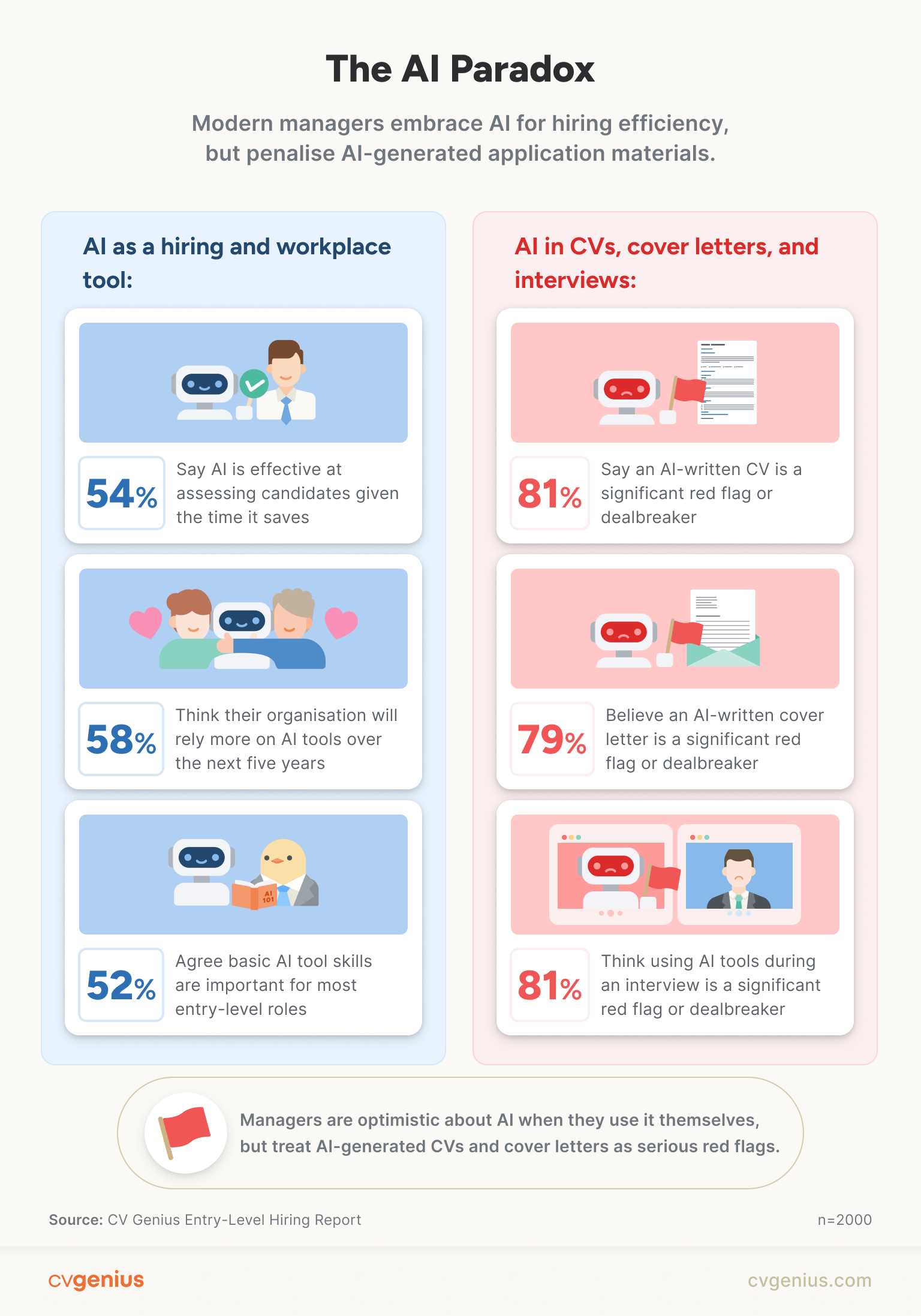
- Live AI use during interview: 56% (significant negative or dealbreaker)
- CV appears fully AI-written: 55% (significant negative or dealbreaker)
- Cover letter appears AI-written: 50% (significant negative or dealbreaker)
Here are some other interesting data points we observed:
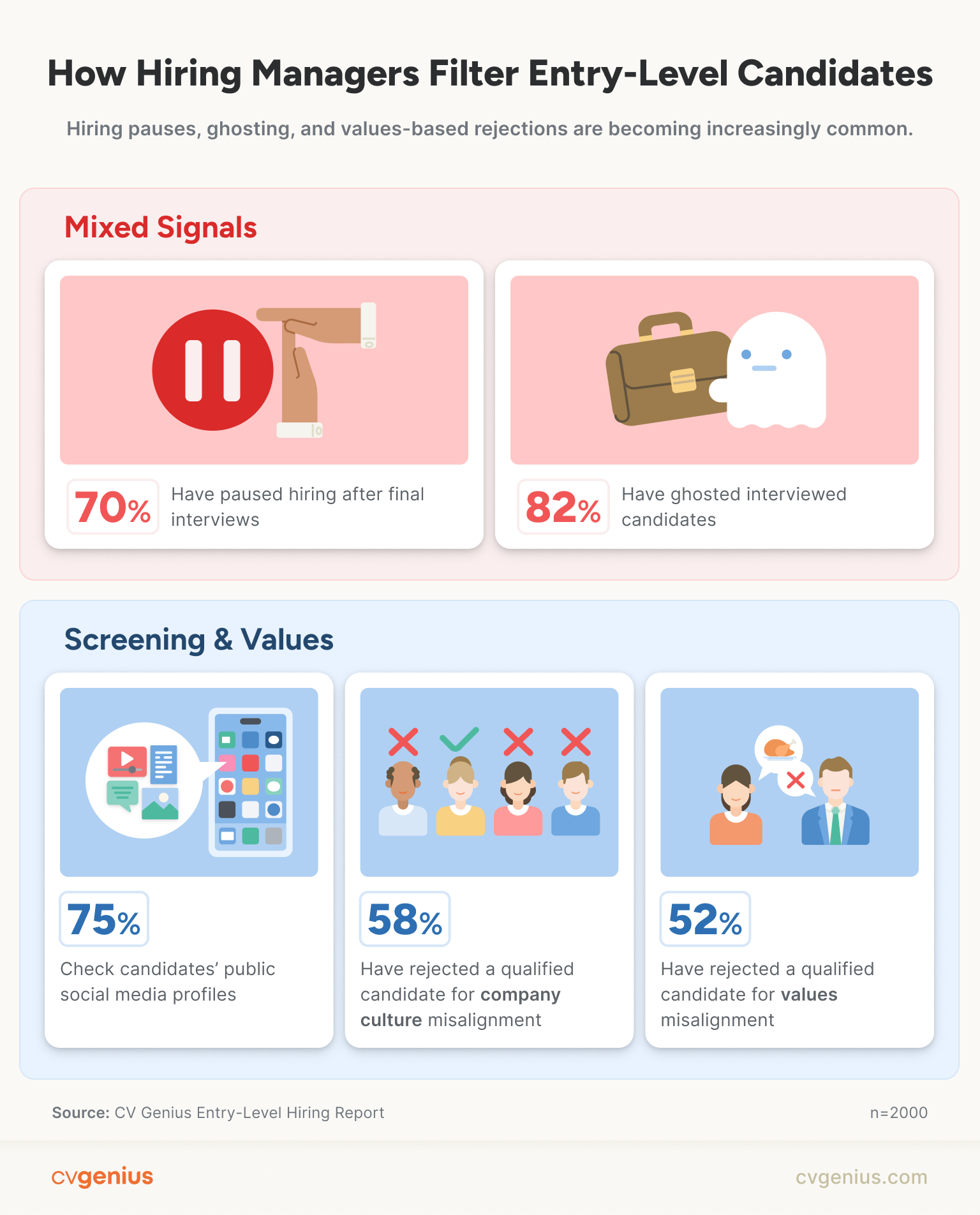
- The new background check: Digital behaviour now acts as a decisive filter. 76% of managers check public social media at least ‘sometimes’, and 59% admit to rejecting an otherwise qualified candidate due to a perceived misalignment with company culture
- The ‘skills gap’ is behavioural: Managers are more likely to fire a new hire for poor communication (13%) or missing deadlines (22%) than for lacking technical ability
Generational findings: Younger managers are the most sceptical of their peers
A striking trend emerges across generations: Gen Z and Millennial managers are often the most critical of entry-level applicants. Younger managers are more likely to cite ‘lack of commitment’ as a primary reason for rejection, suggesting heightened sensitivity to the job-hopping behaviours of their own age groups.
Below is the breakdown of managers citing ‘lack of long-term commitment’ as a rejection reason:
- Baby Boomers: 50%
- Gen X: 47%
- Gen Z: 45%
- Millennials: 42%
Below is the breakdown of managers citing ‘lack of strong work ethic’ as a rejection reason:
- Gen X: 40%
- Baby Boomers: 39%
- Millennials: 37%
- Gen Z: 33%
Here are some other interesting data points we observed:
- Social media scrutiny: Gen Z managers are the most likely to ‘always’ or ‘often’ check a candidate’s social media (39%), compared to just 16% of Baby Boomers
- Public posting penalty: More than one-third (36%) of Gen Z managers say they ‘often’ or ‘always’ see candidates publicly posting about the hiring process, a behaviour that only 7% of Boomers observe frequently
Gender findings: Men are stricter on values; women focus on reliability
Men and women screen for different types of ‘red flags’ during the hiring process. Male managers are more likely to reject candidates based on personal values or cultural fit, whereas female managers tend to focus more on indicators of reliability, such as work ethic and long-term commitment.
Below is the breakdown of ‘Work Ethic’ concerns by gender:
- Male managers: 39%
- Female managers: 35%
Here are some other interesting data points we observed:
- Values-based rejection: Men are more likely to reject qualified candidates due to a perceived conflict in personal values (17% often/always) than women (11%)
- Commitment concerns: Women are slightly more likely than men to cite a ‘lack of long-term commitment’ as a rejection reason (45% vs. 43%)
Salary and negotiation
Many graduates worry that negotiating an entry-level salary will appear ungrateful. However, most hiring managers see respectful negotiation as a sign of maturity. 80% agree that a well-researched, professionally delivered negotiation reflects positively on a candidate’s confidence and preparedness.
Overall findings: Fortune favours the brave
Negotiation is broadly interpreted as competence. Managers confirm that a failed negotiation rarely harms the hiring decision, and a significant majority say they are willing to be flexible if a candidate presents a compelling case.
Below is the breakdown of how managers view negotiation overall:
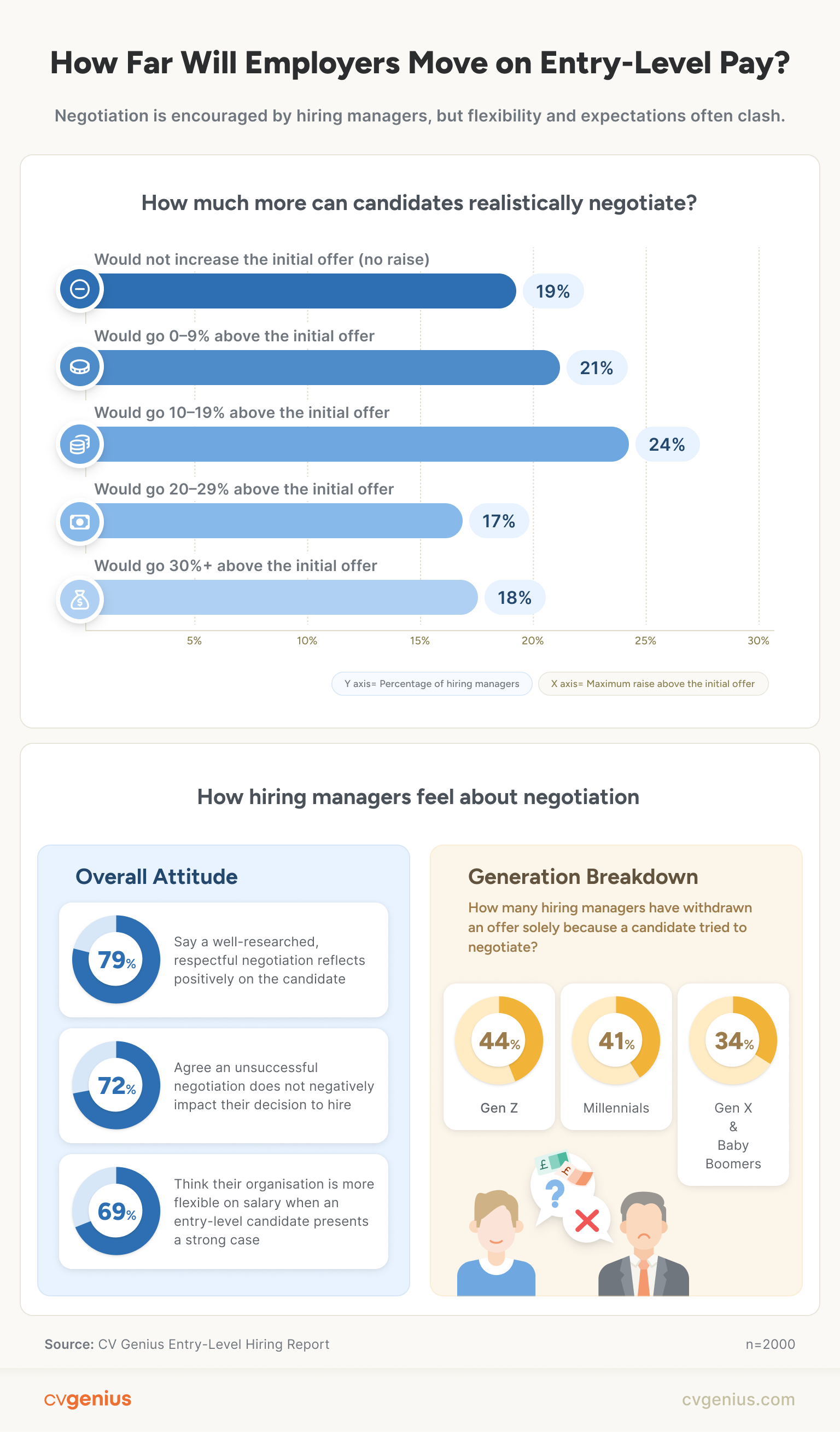
- 79% agree that a respectful negotiation reflects positively on a candidate’s confidence
- 72% say that an unsuccessful negotiation does not negatively impact their hiring decision
- 69% say their organisation is likely to be flexible on salary when a candidate presents a strong case (e.g., standout skills)
- 46% explicitly expect entry-level candidates to attempt salary negotiation
Below is a breakdown of the maximum salary increase managers are typically willing to give:
- 20% or more: 36%
- 10% – 19%: 24%
- 1% – 9%: 21%
- 0% (No increase possible): 19%
Here are some other interesting data points we observed:
- Flexibility exists: 72% of managers say their organisation is willing to be flexible on salary if an entry-level candidate provides a strong rationale (e.g., standout skills or qualifications)
- The transparency gap: Despite valuing negotiation, only 41% of Gen X and 42% of Baby Boomers ‘always’ include salary ranges in job adverts, compared with just 25% of Gen Z managers
Generational findings: Gen Z managers are volatile negotiators
Although negotiation is widely viewed as a positive behaviour, tolerance for it varies sharply by generation. Younger managers — especially those in Gen Z — are considerably more likely to withdraw an offer if a candidate negotiates too assertively. This counterintuitive pattern suggests that younger hiring managers may face tighter budget constraints or feel pressured to project authority or decisiveness early in their careers.
Below is the breakdown of managers who say they’ve withdrawn an offer solely because a candidate negotiated:
- Gen Z: 44%
- Millennials: 41%
- Gen X: 34%
- Baby Boomers: 34%
Below is the breakdown of managers willing to increase an initial offer by 20% or more:
- Gen Z: 49%
- Millennials: 40%
- Gen X: 23%
- Baby Boomers: 20%
Here are some other interesting data points we observed:
- Unrealistic expectations: Older managers are far more sceptical of graduates’ salary expectations. 77% of Baby Boomers believe entry-level candidates have ‘unrealistic salary expectations’, compared with 61% of Gen Z managers
- Timing preference: Gen Z managers are the most open to discussing salary later in the hiring process (e.g., after an offer), with 36% preferring this approach, compared to just 21% of Boomers, indicating a preference for earlier clarity
Gender findings: Men are quicker to rescind offers
Gender dynamics play a clear role in negotiation outcomes. Although both men and women generally view negotiation positively, male managers are statistically more likely to react negatively to a candidate who negotiates, resulting in a higher rate of offer withdrawal.
Below is the breakdown of offer withdrawals due to negotiation by gender:
- Male managers: 44%
- Female managers: 33%
Here are some other interesting data points we observed:
- Positive perception: Despite being more likely to rescind an offer, male managers are slightly more likely to agree that respectful negotiation reflects positively on a candidate (80%) compared with female managers (79%)
- Flexibility: Female managers are marginally more likely to say their organisation is flexible on salary for strong candidates (73%) than men (70%)
Conclusion
The current entry-level job market reveals a clear disconnect between graduate expectations and employer demands. While organisations continue to invest in early-career talent, hiring managers increasingly prefer candidates who arrive with practical experience, strong soft skills, and polished application materials.
Meanwhile, AI familiarity ranks lower in importance than many applicants assume — and can even harm a candidate’s prospects when overused or poorly executed.
Across the findings, one theme is consistent: employers are not short of applicants, but short of applicants who feel job-ready from day one. This shapes decisions around screening, interview behaviour, culture fit, and even salary negotiation. Experience matters, but behaviours and communication matter more.
Many managers still view entry-level hiring as essential to long-term talent pipelines, even as expectations rise.
Methodology
This report is based on a survey of 2,000 hiring managers for entry-level roles in the United Kingdom, conducted by Pollfish using its Random Device Engagement (RDE) methodology to ensure a diverse and demographically balanced sample. All respondents were screened to confirm that they were directly responsible for hiring or managing entry-level employees within their organisation.
The survey covered key topics including experience requirements, desired skills, application behaviours, interviewing practices, AI usage, negotiation attitudes, and demographic differences across age and gender groups.
Data analysis was conducted by CV Genius using standard statistical methods to produce overall findings and demographic comparisons. Analysis was conducted using Python, with libraries such as Pandas and NumPy, alongside manual review. Percentages were rounded to the nearest whole number, with any deviations falling within standard rounding margins. For further details or media inquiries, please contact sade@cvgenius.com.
About CV Genius
CV Genius is the go-to CV maker for UK job seekers of all industries and experience levels. CV Genius also offers a powerful cover letter generator, extensive CV template library, industry-specific CV examples, as well as guides on how to write a perfect CV and cover letter.
Backed by a team of expert career advisors and HR specialists, CV Genius provides in-depth guidance on CV writing, job search strategies, and interview preparation. Its expertise has been featured in leading publications including The Times, the BBC, Forbes, Business Insider, Glassdoor, and MSN.
For media inquiries, please contact us.









Copy Link
Facebook
Linkedin
Twitter
Pinterest