





Drawing on the latest UK and international data, our AI in the UK Report explores how AI is transforming the workplace. It identifies which skills are gaining value, which sectors are most vulnerable to disruption, and how job seekers can prepare to adapt to an AI-driven economy.
How AI is affecting the UK workplace
According to the IMF, AI is expected to impact 40% of jobs worldwide, and the UK is no exception. Since late 2024, the country has lost over 250,000 jobs, with unemployment rising to 4.6% by April 2025. While broader economic conditions and high labour costs are major factors, automation is increasingly contributing to job losses.
The Office for National Statistics (ONS) recorded a record high Labour Cost Index (LCI) of 231.1 in March 2025, prompting many firms to accelerate the use of automation, particularly for roles involving repetitive or administrative tasks (The Guardian).
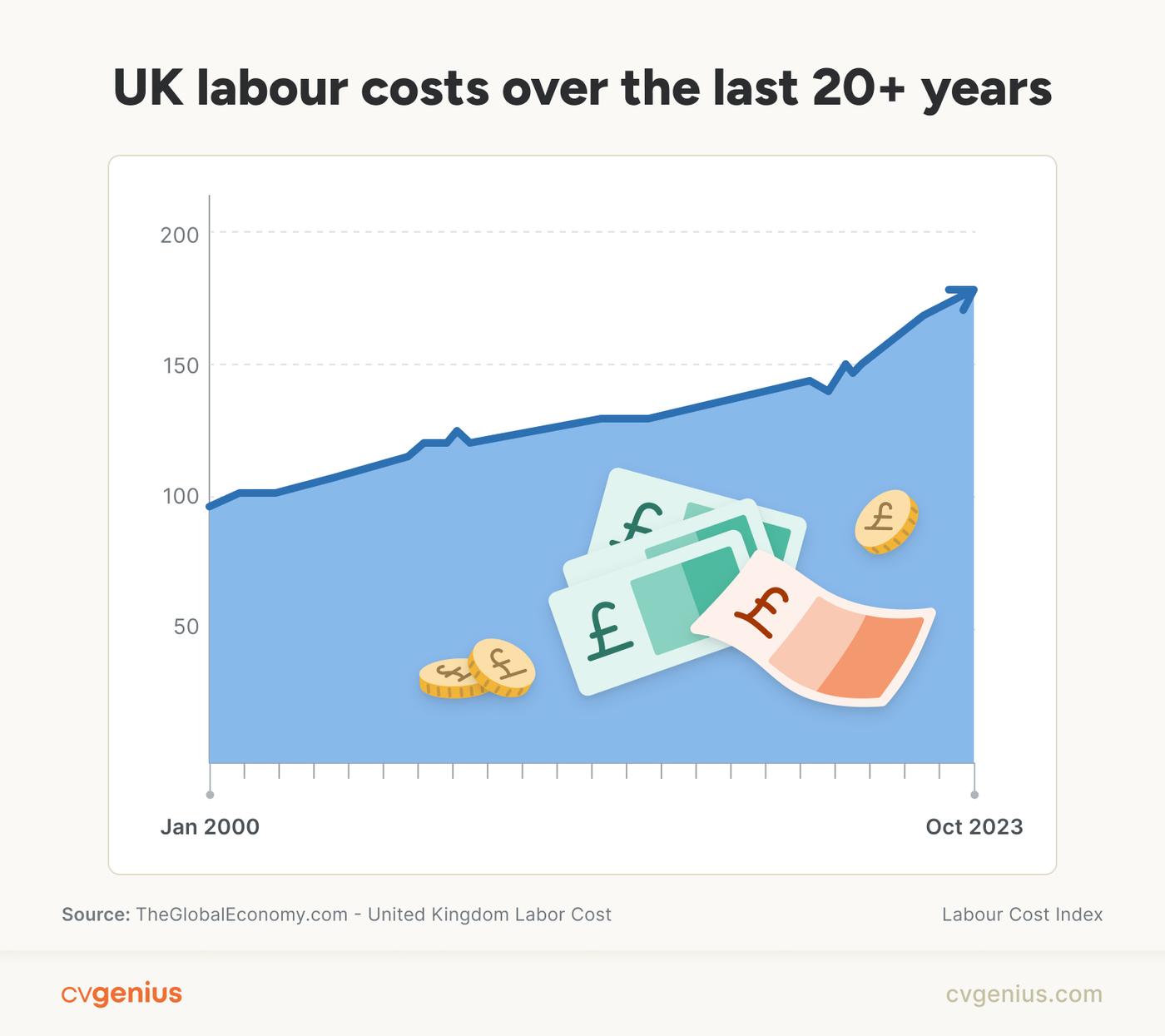
Job postings have fallen sharply, especially in roles with high AI exposure. Between 2022 and 2025, job ads for low-AI-exposure roles dropped by 21%, while postings for high-AI-exposure roles fell by 38%. (McKinsey & Company)
Even though only 10–20% of workers report that AI tools are mandatory in their jobs, companies are already reallocating budgets away from labour. A Boston Consulting Group survey found that half of UK firms plan to shift spending from staffing to AI systems.
Adoption varies by company size:
- Mid-sized companies (250+ employees): About one-third of employees already use AI and large language models (LLMs)
- Large firms: 68% had adopted this technology as early as 2020 (DCMS, McKinsey)
However, this adoption is geographically uneven: London and the South East lead the charge, while regions such as the North East lag significantly behind.
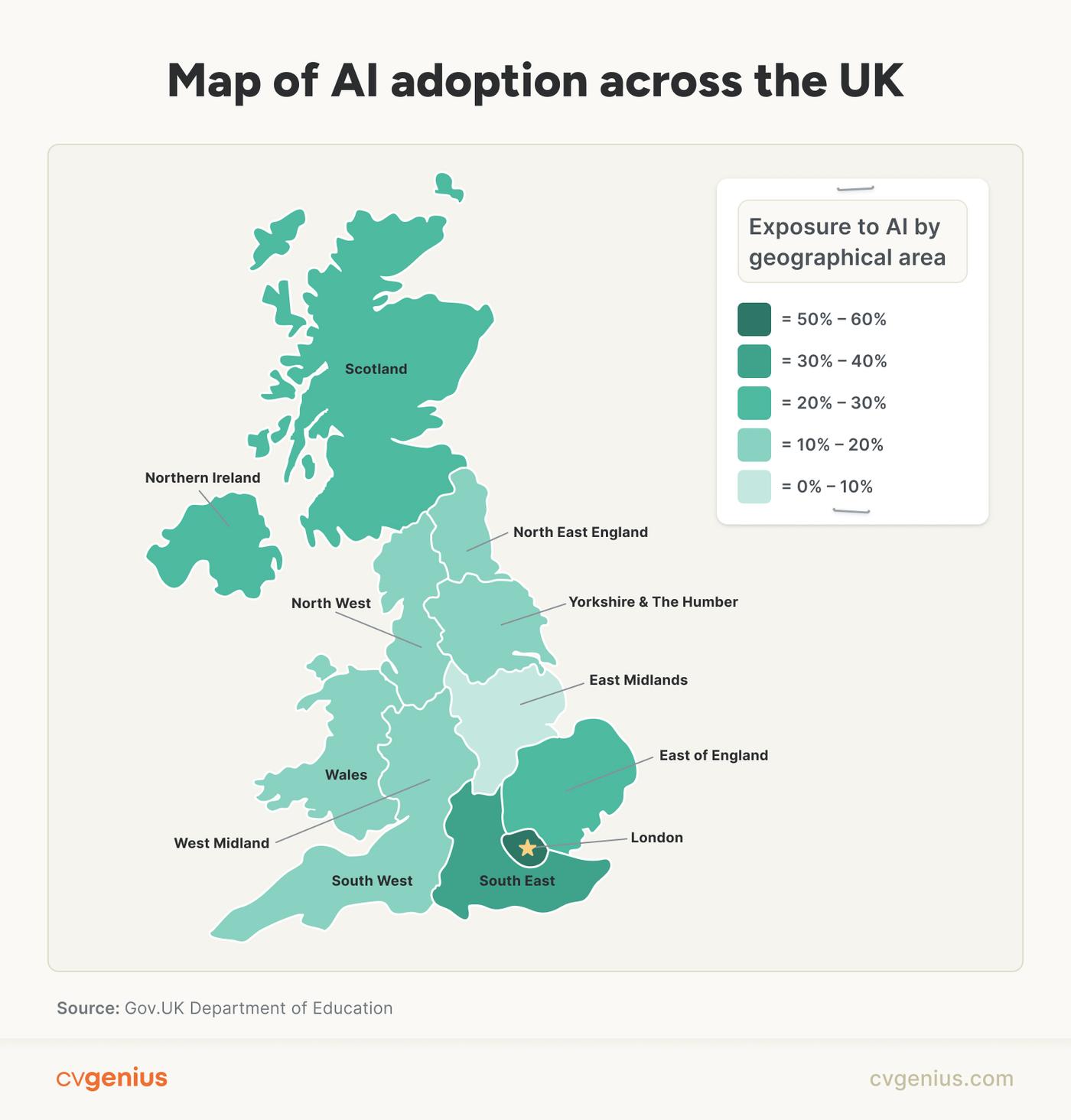
As AI adoption increases and reshapes hiring practices, major questions remain around the future of the UK workforce.
What does the future of AI look like in the UK?
According to the International Trade Administration, the UK is now the third-largest AI market in the world, behind only the US and China. The market is projected to exceed £751.85 billion ($1 trillion) by 2035.
However, this growth comes with significant changes. The IMF estimates that nearly 70% of UK jobs have ‘high AI exposure.’
The PwC 2025 Global AI Jobs Barometer – UK Analysis highlights key trends:
- Demand for AI-skilled roles continues to rise, especially in Information & Communication, Financial Services, and Professional Services
- Health & Social Care sector job postings doubled, rising from 0.5% in 2023 to 1.1% in 2024
- Skills in AI-heavy jobs are changing 66% faster than in other roles, up from 25% the previous year
- Degree requirements are falling: Among high-AI-exposure roles, the share requiring a degree dropped from 64% in 2019 to 56% in 2024
- Jobs requiring AI skills are still growing, peaking at 1.4% of all UK job vacancies in 2024
AI skills are quickly becoming a key factor in whether you get a job, particularly in industries with high AI adoption. Workers themselves are noticing the rising demand for AI skills:
- 91% of workers believe that AI will require constant upskilling and learning (CV Genius)
- 84% think knowing how to use AI tools will make them more hireable (CV Genius)
- There has been a 292% year-on-year growth in early-career professionals (less than 1 year of work experience) listing AI skills on their profiles (Randstad)
With AI, companies can cut costs by downsizing teams while retaining highly skilled or specialised employees. This shift is especially concerning for entry-level workers and new graduates, as companies hesitate to hire for roles they believe could be automated in the near future.
Though only around 11% of tasks (hours worked) in the UK are exposed to AI, the IPRR report predicts that 59% of tasks will be exposed to integrated AI systems in the future.
The same report has also created several scenarios that show what the future of work in the UK would look like if a second-wave adoption of AI takes hold:
Worst-case scenario (full displacement):
- 7.9 million jobs lost
- No GDP gains
Central scenario:
- 4.4 million jobs lost
- +6.3% GDP increase (£144 billion annually)
Best-case scenario (full augmentation):
- 0 jobs lost
- +13% GDP increase (£306 billion annually)
To prepare for these possibilities, the UK has launched initiatives like the AI Opportunities Action Plan and TechFirst, programmes that aim to upskill 7.5 million workers by 2030. However, experts warn that these efforts may fall short. A 2025 Policy Connect report cautions that the ‘exponentially widening skills gap risks cementing the UK’s position in a global skills race it cannot afford to lose.’
As automation accelerates and entry-level roles continue to shrink, the focus is now on how ready UK workers are to adapt.
The skills gap: The UK is falling behind on AI readiness
Despite being a top player in the global AI market, the UK lags behind other nations in AI workforce development.
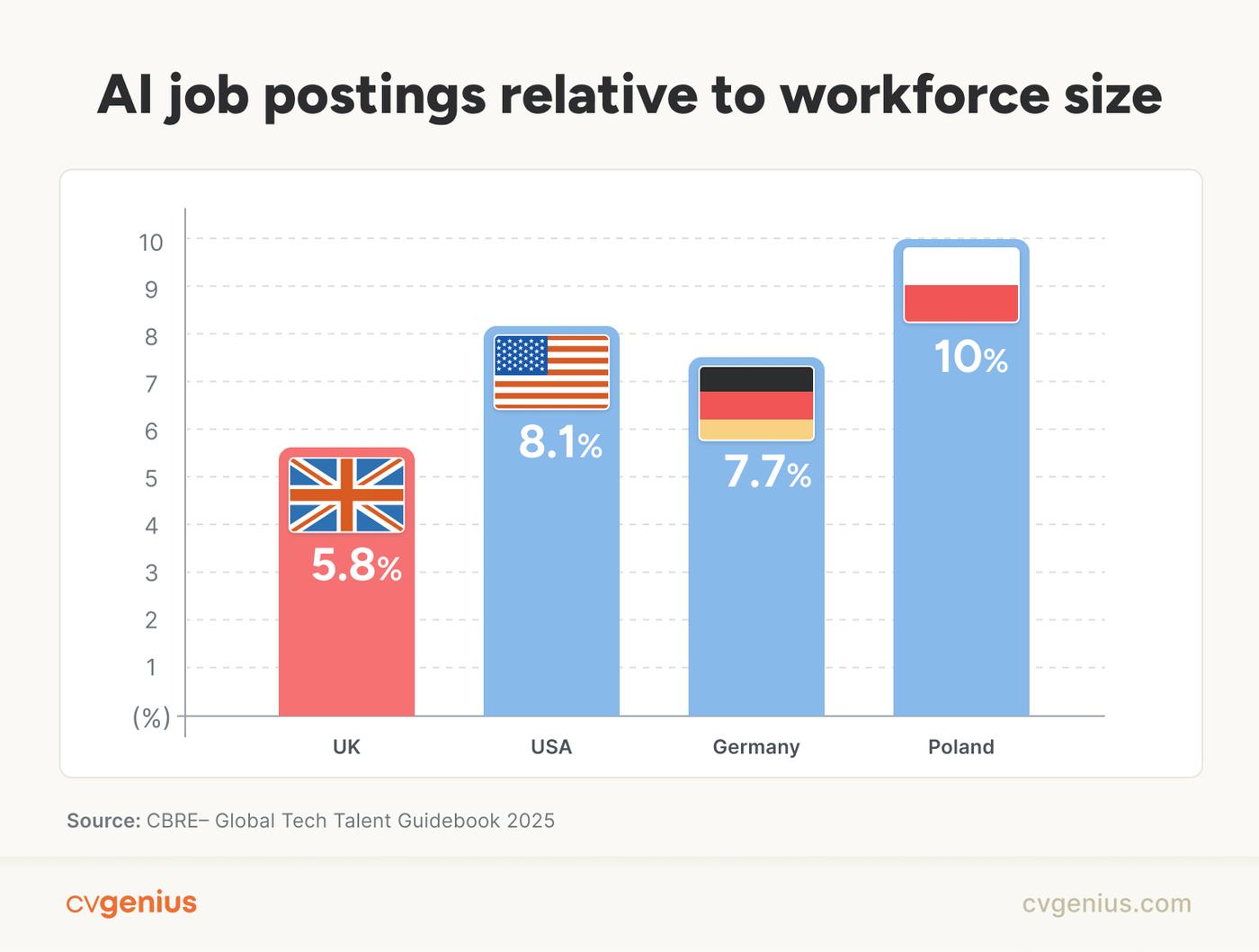
A CBRE report highlights the gap:
- Only 5.8% of UK AI professionals have job postings targeting their skill set
- 8.1% in the US
- 7.7% in Germany
- A surprising 10.0% in Poland, despite a much smaller talent pool, showing strong employer demand
Reskilling is on the rise:
- 80% of UK business leaders plan to retrain employees for AI adoption (Orgvue)
- 41% have increased learning and development budgets to deliver the right training
However, training doesn’t always translate to job security:
- 62% of employers admit they don’t feel responsible for preventing redundancies
- 39% say they’ve already replaced workers with AI systems
Randstad data echoes this tension:
- 75% of UK companies have adopted AI
- Yet, only 35% of workers received any AI training in the last year
Who’s at risk? A look into the jobs most vulnerable to AI
AI’s impact on the workforce varies by role and sector. According to the Department for Education, the sectors with the highest exposure to AI include:
- Clerical and administrative work
- Finance and law
- Business management roles
Meanwhile, these jobs are the most likely to be affected by both AI and LLMs:
- Management consultants
- Solicitors
- Accountants
- Psychologists
- Legal professionals
- Telephone salespersons
The Department for Education also identified a list of jobs with the highest risk of full automation. We’ve provided their annual median wage, number of jobs, and ordered them by highest AI automation risk for reference.
Here are some key insights:
- Average annual median wage (2024) for this group: £28,764
- This is £2,838 less than the average national wage
- Average automation risk: 78%
These are the top 10 jobs with the highest risk of being fully automated:
10 UK Roles Most Likely to Be Replaced by AI
| Job Title | Annual Median Wage (£) | No. of Jobs | AI Automation Risk |
| Bookkeepers, payroll managers, and wage clerks | £25,889 | 249,000 | 94% |
| Telephone salespersons | £25,975 | 6,000 | 94% |
| Pensions and insurance clerks and assistants | £26,226 | 30,000 | 87% |
| Bank and post office clerks | £25,987 | 82,000 | 87% |
| Brokers | £47,158 | 17,000 | 85% |
| Customer service representatives | £23,356 | 365,000 | 76% |
| Travel agents | £24,730 | 20,000 | 75% |
| Finance officers | £26,411 | 24,000 | 70% |
| Librarians | £29,931 | 24,000 | 68% |
| Authors, writers, translators | £31,979 | 17,000 | 55% |
This shift mirrors a broader global pattern identified by the World Economic Forum: the fastest-growing roles by 2030 are expected to be in technical specialist-focused roles, while clerical positions are among those most likely to decline.
A Resume Genius report on the US job market highlights the gap:
- Clerical job growth: declining at 5%
- Specialist job growth: increasing by 11%
- Average 2024 annual wage difference: nearly $65,000 (£48,975) a year
This trend is especially troubling for young people entering the workforce. A 2023 McKinsey study found that jobs requiring fewer than three years of experience are 50% more likely to be automated.
The UK’s Institute for Public Policy Research (IPPR) has warned that without targeted intervention, today’s young workers risk becoming the first ‘AI generation’ left behind.
The inequality gap is widening
AI is deepening existing workplace inequalities, making it harder for entry-level workers and graduates to get hired.
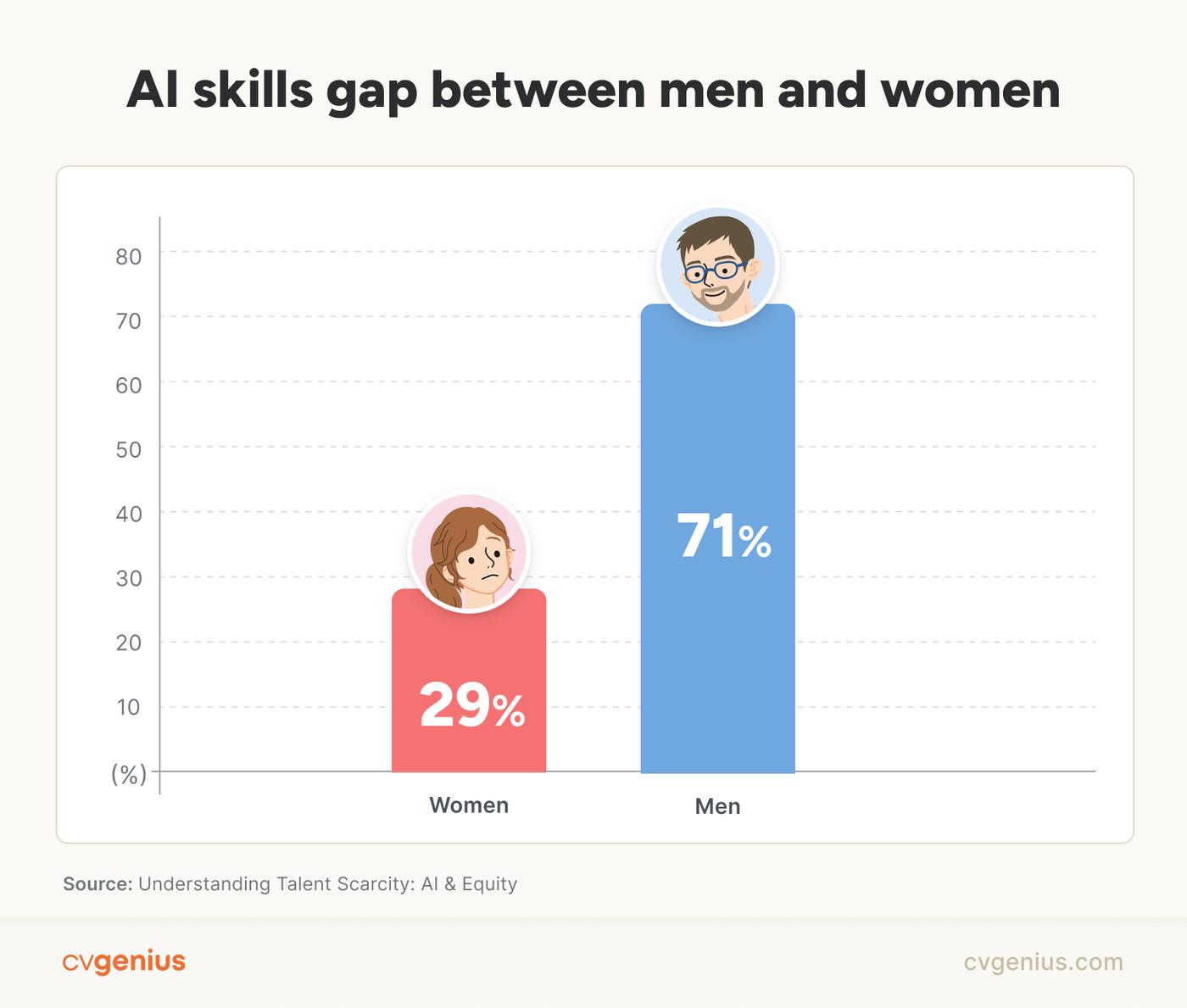
A Randstad survey of 12,000 workers revealed a striking gender gap problem in AI skills:
- 29% of women report having AI skills, compared to 71% of men
This imbalance is also visible in AI-specialised fields:
- Software development: 82% male
- AI data processing: 81% male
- AI cloud applications: 80% male
- Applied machine learning: 77% male
- Deep learning: 76% male
- Generative AI: 69% male
Despite the gender gap in skills, upskilling opportunities are lacking for both genders. Fewer than 50% of both male and female workers are offered AI-related upskilling opportunities by their employers.
How workers can future-proof their jobs
As AI reshapes the economy, workers must adapt to remain employable. Here are 4 strategies to future-proof your career:
1. Upskill with AI in mind
Learn tools relevant to your field, whether that’s prompt engineering, ChatGPT, AI-powered analytics, or workflow automation. Platforms like Coursera, edX, and LinkedIn Learning are great starting points for structured courses.
2. Strengthen your digital and technical skills
According to PwC, demand for AI expertise is growing fastest in information & communication, finance, and health & social care. Highly valued technical skills include:
- GenAI
- PyTorch
- Machine learning & applied machine learning
- Deep learning
- Supervised training (Forbes)
3. Emphasise your soft skills
Soft skills are hard to automate. Remember to include them in your resume! Some in-demand soft skills include:
- Strategic thinking
- Communication
- Honesty and integrity
- Critical thinking
- Adaptability (Forbes)
4. Update your CV with your new AI skills
Workers who display AI skills on their CV are more likely to get hired. Show employers you’re AI-ready by updating your CV, LinkedIn, or portfolio to reflect the AI tools you’ve used.
For early-career workers, even basic AI-adjacent skills can help overcome entry-level hiring freezes. Staying engaged with tech trends and experimenting with new tools can make your work faster and smarter.
Conclusion
The UK stands at a critical point in its AI journey, balancing extraordinary economic opportunity against the risk of widening inequality.
By investing in faster, broader, and more inclusive workforce preparation, the UK can shape a future where AI enhances rather than replaces human potential. But the responsibility doesn’t rest on government mandarins alone. Job seekers must be proactive and continuously upskill to adapt to stay competitive in today’s changing workforce.
Methodology
This report draws on the most recent and reputable sources to examine how artificial intelligence is reshaping the UK labour market. Findings are based on analyses of publicly available data, research reports, and labour market insights published between 2022 and 2025.
Key sources include studies and datasets from:
- The Office for National Statistics (ONS)
- McKinsey & Company
- The World Economic Forum
- The Institute for Public Policy Research (IPPR)
- PwC
- Boston Consulting Group
- The Department for Digital, Culture, Media and Sport
- Randstad
- other UK and international organisations
To ensure relevance, the piece focuses on:
- The latest statistics on AI job exposure, wage growth, and labour demand
- Research offering national-level or sector-specific breakdowns
- Comparative insights showing differences between the UK and other major economies, such as the US and Germany
Where UK-specific data was limited (e.g., in long-term job growth projections), we incorporated global and US-based findings to illustrate broader trends, supplemented by UK-focused commentary and implications.
Sources
- CBRE, Global Tech Talent Guidebook 2025
- CV Genius, 10 Jobs AI Will Replace in 2025
- Department for Digital, Culture, Media and Sport (DCMS), AI Activity in UK Business
- Department for Science, Innovation & Technology, AI Opportunities Action Plan
- Department for Education, The Impact of AI on UK Jobs and Training
- Financial Times, UK Companies Plan to Invest in AI Instead of Hiring Staff as Costs Rise
- Forbes, 5 Soft Skills That Are Critical In The Age Of AI
- Forbes, ’10 AI Skills To Boost Your Salary Up To 47% In 2025
- GOV.UK, PM Launches National Skills Drive to Unlock Opportunities for Young People in Tech
- Institute for Public Policy Research, Transformed by AI
- International Monetary Fund, Gen-AI: Artificial Intelligence and the Future of Work
- International Trade Administration, United Kingdom Artificial Intelligence Market 2023
- McKinsey & Company, Not Yet Productive, Already Disruptive: AI’s Uneven Effects on UK Jobs and Talent
- McKinsey Global Institute, Generative AI and the Future of Work in America
- Office for National Statistics, Earnings and Hours Worked, Occupation by Four-Digit SOC: ASHE Table 14
- Orgvue, 55% of Businesses Admit Wrong Decisions in Making Employees Redundant When Bringing AI into the Workforce
- Policy Connect, Skills in the Age of AI
- PwC, The Fearless Future: 2025 Global AI Jobs Barometer. UK Analysis
- Randstad, Understanding Talent Scarcity. AI & Equity Report
- Resume Genius, AI vs. Entry-Level Jobs Report: What Roles Are Disappearing
- The GlobalEconomy.com, United Kingdom Labour Cost
- The Guardian, Could AI be Accelerating Slowdown in the UK Job Market?
- Will Robots Take My Job?, Will Robots Take My Job?
- World Economic Forum, Future of Jobs Report 2025: These Are the Fastest Growing and Declining Jobs
About CV Genius
CV Genius is the go-to CV maker for UK job seekers of all industries and experience levels. CV Genius also offers a powerful cover letter generator, extensive CV template library, industry-specific CV examples, as well as guides on how to write a perfect CV and cover letter.
Backed by a team of expert career advisors and HR specialists, CV Genius provides in-depth guidance on CV writing, job search strategies, and interview preparation. Its expertise has been featured in leading publications including The Times, the BBC, Forbes, Business Insider, Glassdoor, and MSN.
For media inquiries, please contact us.











Copy Link
Facebook
Linkedin
Twitter
Pinterest